
The wreck at grid TR2872937867, off Dover, behaves like a suspect who cannot keep his story straight. The strongest named candidate for this exact grid is Helene. The wreck’s long-standing local nickname, Orangeman, points towards her. Lloyd’s reported the German steel steamer lost in 1907 after a collision about one mile west of Admiralty Pier. She was travelling from Valencia to Antwerp with fruit. Historic England also preserves the local story behind the name. According to that account, oranges from the wreck were sold to help the survivors. Divers also reportedly recovered a bell inscribed HELENE. That sounds persuasive. Annoyingly persuasive, in fact. Then the evidence starts making faces at us. The same wreck record says the hold contained train bogie wheels. Those do not fit a fruit steamer in any obvious way. So Helene remains the best named candidate for the exact site, but she comes with a proper snag. [+]
Halcyon and the Brandy Boat problem
Halcyon fits another part of the puzzle much better. This British cargo steamer was built in 1915 for General Steam Navigation. She carried official number 139054. On 7 April 1916, she was mined while travelling from Bordeaux to London with general cargo. The nickname Brandy Boat makes sense for a Bordeaux trader. Historic England records a nearby wreck at 51°05.36’N 01°16.17’E as the local Brandy Wreck. In 1989, that wreck was regarded as “almost certainly” Halcyon. That gives us a much cleaner explanation for the brandy story. It works better than trying to force Halcyon onto the exact Orangeman grid. But there is a problem. A large one, naturally, because wreck research enjoys wasting everyone’s afternoon. Halcyon’s recorded war-loss position, 51°01’N 01°10’E, lies about 10.7 km, or 5.8 nautical miles, from the quoted grid. That gap is too large to brush aside. [+]
Why Torbay II looks like a red herring
HMT Torbay II looks like a red herring for the Orangeman site itself. Historic England records Torbay II separately, east of the site. She was a 1910 steel drifter, later used as an auxiliary patrol boat. An air attack sank her off Dover on 1 November 1940. Her associated finds tell a different story. They include military and shipboard service items: shell cases, a Very pistol, a telegraph, and chainwork. Those finds fit a patrol vessel. They do not fit a fruit trader or a Bordeaux general-cargo coaster. [+]
My working verdict
So, my verdict remains ranked but cautious. For the exact grid TR2872937867, Helene is the best named candidate currently available. But the identification must stay provisional. For the nearby Brandy Boat mark, Halcyon fits better. The most convincing model is a two-site cluster. One site may represent Helene. Another may represent Halcyon. The bogie wheels also leave open the possibility of a third vessel or a mixed debris field at the exact grid. Torbay II ranks far below the others for the Orangeman site. In detective terms, Helene is the prime suspect. Halcyon is implicated in the next room. And the bogies suggest the house may contain one more body than the first inventory admitted. [+]
Sources and limits
I have leaned hardest on the most authoritative material I could verify online. These include:
- Digitised Lloyd’s casualty returns from Lloyd’s Register Foundation.
- Historic England wreck records – Torbay II.
- Historic England wreck records – Halcyon
- The Halcyon crew agreement catalogue at Royal Museums Greenwich.
- The shipyard record on Clyde Ships.
- An object-provenance note from The London Library.
- Royal Navy loss summaries for Torbay II.
- Wrecksite.eu – SS Helene [+1907]
- Wrecksite.eu – SS Halcyon [+1916]
- Wrecksite.eu – HMT Torbay II [+1940]
These sources frame the case well. They do not close it beyond all reasonable doubt. I did not find a digitised Board of Trade inquiry transcript for the Helene collision. Nor did I find a digitised Admiralty loss file for Halcyon with a cargo manifest detailed enough to prove or disprove the brandy story.
Working assumptions
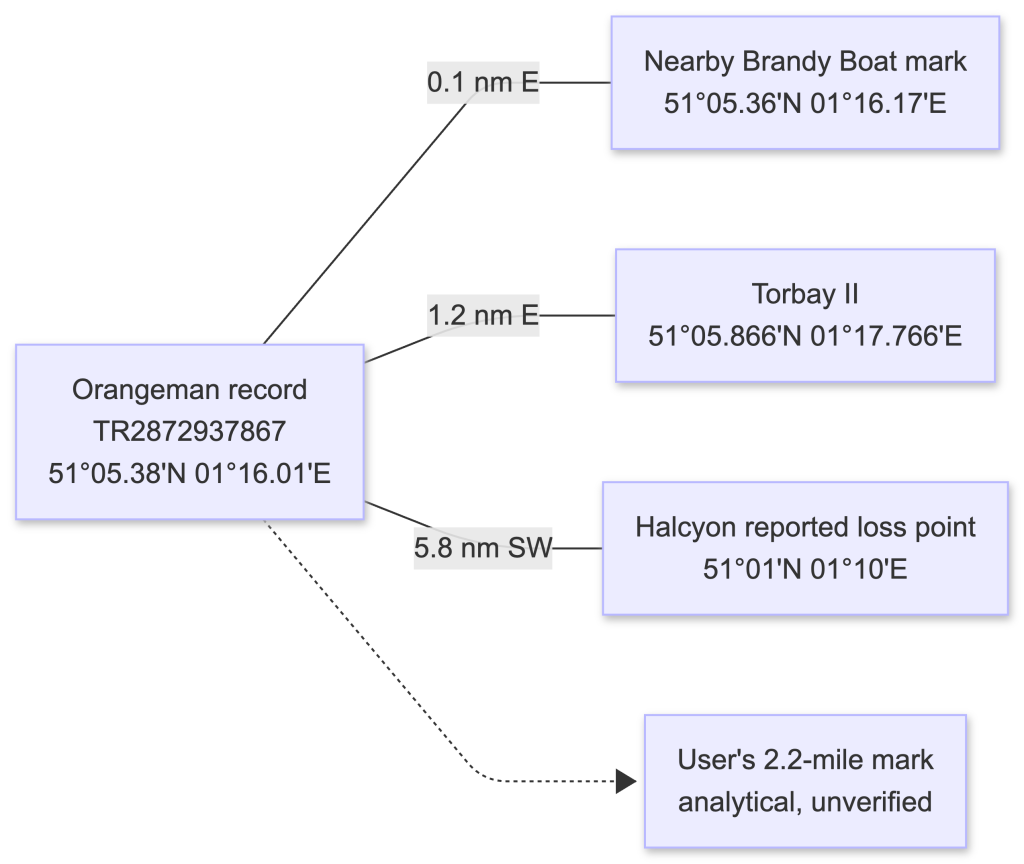
Three assumptions shape the analysis below. First, I treat the quoted grid and published wreck coordinates as broadly sound. Even so, old charting often contains a little fuzziness. Maritime history does like to leave its homework in the rain. Second, I treat the HELENE bell, the Orangeman nickname, and the Brandy Boat nickname as real reported clues. I do not treat them as forensic proof. That matters because I could not verify a public museum accession trail for the bell or the bottle assemblage. Third, I could not verify the earlier 2.2-mile mark from the present public record. So, in the diagram below, I show it only as an analytical marker. I do not present it as a confirmed historical datum.
Sources and limits
I have leaned hardest on the most authoritative material I could verify online. These include:
- Digitised Lloyd’s casualty returns from Lloyd’s Register Foundation.
- Historic England wreck records.
- The Halcyon crew agreement catalogue at Royal Museums Greenwich.
- The shipyard record on Clyde Ships.
- An object-provenance note from The London Library.
- Royal Navy loss summaries for Torbay II.
These sources frame the case well. They do not close it beyond all reasonable doubt. I did not find a digitised Board of Trade inquiry transcript for the Helene collision. Nor did I find a digitised Admiralty loss file for Halcyon with a cargo manifest detailed enough to prove or disprove the brandy story.
Working assumptions
Three assumptions shape the analysis below. First, I treat the quoted grid and published wreck coordinates as broadly sound. Even so, old charting often contains a little fuzziness. Maritime history does like to leave its homework in the rain. Second, I treat the HELENE bell, the Orangeman nickname, and the Brandy Boat nickname as real reported clues. I do not treat them as forensic proof. That matters because I could not verify a public museum accession trail for the bell or the bottle assemblage. Third, I could not verify the earlier 2.2-mile mark from the present public record. So, in the diagram below, I show it only as an analytical marker. I do not present it as a confirmed historical datum.
Reading the official wreck record
The official wreck record deserves slow reading. Treat it like a witness statement, with one eyebrow raised. At 51°05.38’N 01°16.01’E, the wreck lies on her port side. Her bow points north-west. A cavern sits under the bow where the vessel rests on a bank. The hull is collapsing. The superstructure lies beside the wreck. The masts lie sideways. The after hold is deeply silted. The propeller causes one small irritation. One note describes it as iron. Another describes it as steel. Maritime records do enjoy leaving banana skins on the floor.
The cargo clues
The same record reports several finds. It mentions train bogie wheels in the hold. It also records packing cases and bottles in the forward hold. Crockery with a Rotterdam stamp came from the galley. These details matter because they do not all point in the same direction. The bogie wheels do not neatly fit the Helene fruit story. The bottles seem to support the Brandy Boat tradition. The Rotterdam crockery may reflect crew use, ship supply, ownership links, or later confusion. The record also shifts over time. A 1978 note described the vessel as lying on her starboard side. Later descriptions place her on her port side. That change smells strongly of a recording error. It may also point to confusion between neighbouring wrecks.
How the identification changed
Historic England’s compilation shows why this case has annoyed divers and researchers for decades. The wreck first appeared as an uncharted wreck in 1976. By June 1978, divers knew it locally as the Orangeman. The recovered bell reportedly read HELENE. By August 1982, the record stated that the wreck had been “confirmed as HELENE”. Then came another twist, because apparently one mystery was too merciful. In July 1989, a nearby wreck called the Brandy Wreck was described as “almost certainly the HALCYON”.
A file full of mixed clues
The Receiver of Wreck entries add more texture. They include a porthole, lamp chimneys, a fork, a ring marked “A Schlanert 4.4.1904”, a telegraph, and brass fittings. Those finds create the real problem. The documentary file no longer reads like one clean identification. It reads like a layered archaeological deposit. Some clues point towards Helene. Some point towards Halcyon. Others may belong to another vessel, or to a mixed debris field around nearby wrecks.
Recorded, but not specially protected
The official material presents this site as a recorded wreck. It also links the site to multiple UKHO and Admiralty chart references. I did not find an equivalent Protected Wreck list entry for it on the National Heritage List. Dover’s protected Langdon Bay site does have such a listing. So, based on the public record reviewed here, the Orangeman appears to be recorded and charted. It does not appear to have separate protected wreck designation.
Why the positions matter
The sketch below plots the published positions. Using those coordinates, the nearby Brandy Boat mark lies about 0.1 nautical miles east of the quoted grid. Torbay II lies about 1.2 nautical miles east. Halcyon’s reported mine-loss position lies about 5.8 nautical miles to the south-west. That spatial logic matters. Cases like this often turn on one mile here and another mile there. Annoyingly, the sea refuses to keep tidy filing cabinets.
Helene: the strongest named candidate
The primary Lloyd’s casualty return identifies Helene as a German steel screw steamer. It gives her tonnage as 503 net and 832 gross tons. Lloyd’s records her loss on 3 March 1907. She was travelling from Valencia to Antwerp with a cargo of fruit. Historic England’s summary appears to draw from the same family of evidence. It narrows the cargo to citrus fruit. A later Dutch maritime-history article gives a slightly different profile. It describes Helene as a 786 BRT vessel, built in 1888, with Flensburg as her home port. It also names H. Schuldt as owner.
What we can safely say
Taken together, the safest conclusion is simple. Helene was a late nineteenth-century German steel coaster or small cargo steamer. She carried fruit from Spain towards northern Europe when she was lost. The online sources do not agree on gross tonnage. I have also not established a secure official number. That is not shocking for a pre-IMO vessel. Still, it leaves a gap in the file.
The voyage discrepancy
One detail needs daylight. Lloyd’s says Valencia to Antwerp. I treat that as the stronger source. The later Dutch article says Valencia to Dover, with a cargo of oranges. That version may preserve a garbled memory of the wreck’s position near Dover. It may also echo the local story about oranges being sold to help the survivors. But it conflicts with the casualty return. My working view is this: Helene’s intended voyage was Valencia to Antwerp. The reference to oranges plausibly describes part of the fruit cargo. On its own, that does not create a contradiction.
Collision, fog, and fatalities
Contemporary newspaper summary material at the Library of Congress states that the German steamers Marsala and Helene collided. It also reports that Helene sank with eight lives lost. A later Dutch ship-history note adds more detail. It says the collision happened in dense fog. It also says the inquiry blamed an insufficient lookout on Helene. I have not found the inquiry transcript itself. So, we should treat that causal finding as second-hand until an official report confirms it. Tedious, yes, but history has a nasty habit of punishing anyone who skips the paperwork. [+] Still, the broad outline looks sound:
- Helene collided with Marsala.
- Fog played a part.
- Helene sank.
- Eight people drowned.
The Orangeman legend
This is where the Orangeman legend starts to look stronger. It no longer feels like dockside pub smoke. It feels more like scorched paper with writing still visible on it. Historic England preserves the tradition that oranges from the wreck were sold to help the survivors. That story fits naturally with a fruit steamer lost off Dover. If genuine, it becomes one of the strongest cultural clues in the whole case.
The problem with provenance
The difficulty lies in provenance. The record gives us the orange story. It does not give us the contemporary newspaper cutting, harbour account, or salvage receipt that would nail it to the desk. So, the story matters. It supports Helene. But we cannot treat it as final proof.
Helene and the artefacts
The artefacts give Helene two strong points and one miserable weakness. The strong points are obvious. Divers reportedly recovered a bell inscribed HELENE. The wreck also carried the local nickname Orangeman. Both clues fit the 1907 fruit steamer well. The packing cases in the forward hold also sit comfortably with a fruit cargo. They may represent cargo remains, packaging, or later debris connected with the same story.
The bogie wheel problem
Then we hit the awkward bit: the train bogie wheels. They do not fit Helene’s documented fruit cargo. Not neatly. Not even with a kind heart and a generous cup of tea. The Rotterdam-stamped crockery does not prove much by itself either. It may reflect continental supply, owner’s stores, later contamination, or material from another vessel. So, Helene explains the name and the bell very well. She may also explain the packing cases. But she hardly explains the bogie wheels at all.
Halcyon: a stronger paper trail
Halcyon has a firmer paper trail than Helene. That makes sense. She was British, younger, and better covered by surviving records. Ship research occasionally rewards paperwork, presumably by accident. Clyde Ships records Halcyon as a cargo screw steamer. Ailsa Shipbuilding Co. Ltd. built her in 1915 as yard no. 290 for General Steam Navigation Co. Ltd., London. She measured about 1,320 gross tons. Her dimensions were 260 ft by 38 ft by 14.8 ft, which converts to roughly 79.2 m by 11.6 m by 4.5 m. She had a triple-expansion engine. The Royal Museums Greenwich crew-agreement catalogue confirms her official number: 139054. It also preserves her 1915 crew list. [+]
Why the crew list matters
That crew list is not trivial wallpaper. Royal Museums Greenwich catalogues 25 men on the book. They include the master, officers, engineers, deck crew, engine-room crew, and hotel staff. The list does not tell us who stood where when the mine exploded in April 1916. [+] But it does prove three important points:
- The vessel’s identity.
- Her official number.
- Her operational status.
Those points stand beyond serious argument.
Halcyon’s wartime loss
Uboat.net, drawing on wartime records, states that Halcyon sank on 7 April 1916. It says UC-6 mined her while she was travelling from Bordeaux to London with general cargo. It gives the position as 51°01’N 01°10’E, about 3.5 miles SW by S of Folkestone Pier. It also records no fatalities. A naval-history summary indexed in search agrees on the route, cargo, and loss date. So, Halcyon gives us a clean wartime casualty profile. Almost too clean, naturally. The problem is position. Her reported loss position does not sit comfortably with the Orangeman grid.
Halcyon and the cargo problem
Now we reach the interesting part. Halcyon’s documented cargo appears only as general cargo. That helps and irritates in equal measure, because apparently history enjoys handing us a torch with flat batteries. It helps because general cargo could include cases, bottles, machinery, fittings, and all manner of oddments. That makes the bogie wheels more plausible than they would ever be on a fruit steamer. But it irritates because general cargo does not prove brandy.
So, the Brandy Boat nickname remains suggestive, not decisive. It may reflect Halcyon’s Bordeaux origin. It may come from broken bottle scatters. It may point to actual spirits cargo. Or it may be simple diver folklore, polished smooth over time by repetition. [+]
A useful salvage clue
One small piece of evidence gives Halcyon’s story extra weight. The London Library holds a water-damaged copy of The planter’s manual. A donor letter explains that the book had been aboard Halcyon when she struck the mine. The same note says the book spent about six months on the bed of the Channel before recovery. That proves one useful point. At least some material from Halcyon was recoverable from shallow water after the sinking. It does not place Halcyon at TR2872937867.
But it does show how portable finds could enter local circulation after the loss. Books, documents, bottles, fittings, and other loose objects could all travel from seabed to shore. Then, with time and retelling, they could become part of a wider wreck tradition.
Where Halcyon becomes useful
This is where Halcyon becomes powerful again. The Historic England record for the Orangeman site mentions a nearby wreck at 51°05.36’N 01°16.17’E. It says divers also called that nearby wreck the Brandy Boat. In 1989, the same nearby wreck was thought to be “almost certainly the HALCYON”. That detail matters. It gives us a cleaner way to separate the two identities, rather than forcing one wreck to explain every clue like a tired detective with one suspect and no lunch.
Separating the two wrecks
The same record also notes a porthole recovered from HALCYON, known locally as the Brandy Boat. That gives us the cleanest documentary path in the file. The best working split is this:
- Helene fits the Orangeman tradition at the exact grid.
- Halcyon fits the nearby Brandy Boat wrecklet immediately east of it.
That model explains more evidence with less squeezing. Which, in wreck identification, is about as close as we get to comfort.
The clue that refuses to behave
This is where the case refuses to sit down. Historic England’s own synthesis admits that the train bogie wheels may indicate “a different vessel entirely”. That is not a dramatic flourish from a diver over tea. It is the official record acknowledging a serious problem. The cargo description may point beyond both Helene and Halcyon. Other details add to the discomfort.
The record gives contradictory notes on whether the wreck lay to port or starboard. It also gives different propeller descriptions. A second wreck lies only a cable or so away. Together, those details strengthen the case for record conflation, mixed debris, or more than one wreck story bleeding into another. Because apparently one mystery wreck was not enough. The sea wanted a filing cabinet tipped down the stairs.
Why the bogie wheels matter
The bogie wheels matter because they are not generic clutter. If they were genuinely in situ cargo, they should point towards a railway-linked or machinery-carrying trade. That might mean a cross-Channel freight vessel or a continental coaster carrying heavier manufactured goods. Neither Helene’s documented fruit cargo nor Halcyon’s surviving public cargo description explicitly mentions railway material. That does not rule out Halcyon. Her cargo appears in the public record as general cargo, which remains broad enough to hide plenty of awkward items. But the bogies keep the third-vessel door open.
Weak continental clues
Two other finds deserve mention, but not too much confidence. The gold ring inscribed “A Schlanert 4.4.1904” may suggest a continental personal link. The Rotterdam-stamped crockery may also point towards continental supply, ownership, or crew use. But both clues remain weak. Neither item can carry the case on its own back.
Why Torbay II enters the file
Torbay II appears in the file for understandable reasons. She lies nearby. She was steel-built. She came later than Helene and Halcyon. She also has her own independent record. That is how ghost identifications often begin. One nearby wreck starts borrowing another wreck’s coat, and everyone pretends this is normal behaviour.
What the record says
Historic England places Torbay II at TR3087238303. The chart records her as HMS TORBAY II (probably). She was a steel drifter built in 1910. Later, she served as an auxiliary patrol vessel. The site measures around 31 to 35 metres long. It lies roughly east-west. The associated artefacts point strongly towards military or shipboard service use. They include:
- Shell cases.
- A hand pump.
- A light.
- A Very pistol.
- A telegraph.
- Chainwork.
Why she does not fit Orangeman
The Royal Navy loss lists record Torbay II as sunk by aircraft off Dover on 1 November 1940. That gives us useful context for the wreck neighbourhood. It does not make her a persuasive identity for the Orangeman site. Torbay II fits a patrol-vessel story. She does not fit the fruit steamer, orange-selling, or Brandy Boat traditions.
Verdict and research plan
Here is the evidence reduced to brass tacks.
| Candidate | What fits | What hurts | Provisional assessment |
|---|---|---|---|
| Helene | Orangeman nickname, bell inscribed HELENE, fruit cargo from Valencia, local orange-selling tradition, loss off Dover in 1907.1 | Train bogie wheels do not fit documented fruit cargo; bell provenance is reported but not accessioned in the public sources reviewed.4 | Best named fit for the exact grid, but still provisional. |
| Halcyon | British steel steamer, ON 139054, Bordeaux to London with general cargo, bottles and packing cases are plausible; nearby Brandy Boat mark was later treated as "almost certainly" Halcyon.2 | Official loss position is about 5.8 nautical miles from the quoted grid; "general cargo" does not prove brandy.2 | Better fit for the nearby Brandy Boat than for TR2872937867 itself. |
| HMT Torbay II | Separate, documented steel wreck east of the area; military artefacts fit its own record.3 | Wrong type, wrong date, wrong artefact profile, wrong position for Orangeman.3 | Very unlikely for the Orangeman site. |
| Third vessel / mixed field | Bogie wheels, Rotterdam-stamped crockery, contradictory site descriptions, and two very close wreck marks all support this possibility.4 | No named third candidate has yet been tied to the grid from the public online record. | A live possibility, especially if the bogies are confirmed in situ cargo. |
My verdict
My clear verdict is this. For the exact grid TR2872937867, I rank the candidates as follows:
- Helene.
- A third vessel or mixed debris field.
- Halcyon.
- Torbay II, a distant fourth.
For the nearby Brandy Boat mark, Halcyon ranks first.
The case in one sentence
If you force me to put the case into one sentence, here it is:
The Orangeman wreck probably is not a simple one-wreck-one-name problem. It looks more like a confused local cluster where Helene and Halcyon have both left their fingerprints.
Date sequence
The date sequence below brings together the casualty returns, wreck records, Royal Navy loss list, and later artefact reporting.
Orangeman Wreck Case Timeline
A late 19th-century German steel steamer enters service.
Helene collides with Marsala and sinks off Dover.
Halcyon is built and later recorded under official number 139054.
Halcyon is mined while on a Bordeaux to London voyage.
A water-damaged Halcyon book is later donated to the London Library.
HMT Torbay II is bombed and sunk off Dover.
The Orangeman site is first noted as an uncharted wreck.
A bell reading HELENE is reported from the wreck.
The record says the wreck was confirmed as HELENE.
The nearby Brandy Wreck is described as almost certainly HALCYON.
Portholes, lamps, telegraph parts, and a ring are logged among later reported finds.
The next stage needs to be ruthlessly practical. No more romantic squinting at folklore until the paper and metal have been forced to talk.
| Priority | What to consult or do | Why it matters |
|---|---|---|
| Immediate archive check | Original Historic England source pack behind HOB UIDs 901809 and 901812, especially source nos. 148 and 150, plus UKHO files for wreck refs 13587 and 13593.4 | This is the quickest way to separate which dive descriptions belong to which wreck. |
| Primary casualty work | 1907 and 1916 Lloyd's casualty returns, then the underlying collision or war-loss files at The National Archives if extant.1 | Needed to verify Helene/Marsala inquiry findings and to see whether Halcyon's cargo was ever itemised beyond "general cargo". |
| Crew and ownership trail | Halcyon crew file RSS/CL/1915/4022/17 at Royal Museums Greenwich.7 | May preserve operational details, owners' forms, crew effects, or annotations relevant to the loss. |
| Receiver of Wreck trail | Droit entries including A/477, 293/02, 139/03, 156/04, 167/03, 162/03, 026/04, 196/01, A/492, A/1775.4 | Essential for locating the bell, portholes, ring, bottles, telegraph and other finds, and for establishing chain of custody. |
| Newspaper trawl | British Newspaper Archive, Gallica, Biblioteca Nacional de España, and Antwerp/FelixArchief port or newspaper holdings. | Best chance of finding the orange-sale story, survivor accounts, and any Helene collision reporting in English, French, Spanish or Belgian press. |
| Underwater survey | Multibeam and diver photogrammetry of both the quoted site and the nearby Brandy Boat mark; targeted exposure of bogie wheels and the galley area. | Hull dimensions may settle whether the exact grid better matches the smaller Helene or the larger Halcyon, and whether the bogies are truly cargo. |
| Forensic artefact work | Read makers' marks on bogie wheels, bottle bases, crockery stamps and bell lettering; compare porthole sizes, telegraph type and lamp fittings by national manufacture. | This is the quickest physical route to nationality, date range and cargo character. |
The unresolved questions
The main unresolved questions are crisp. Was the HELENE bell definitely recovered from the exact grid, or did it come from the nearby wreck? Are the bogie wheels truly in situ cargo, or did they arrive later through intrusion, trawling, dumping, or record confusion? Does Halcyon’s underlying loss paperwork mention branded cases, spirits, machinery, or rail equipment? Can the orange-sale story be tied to a contemporary press notice, rather than left to wander the quay as oral tradition?
Where the evidence now stands
Until we answer those questions, the working verdict stays cautious. Helene remains the best single name for the exact Orangeman grid. Halcyon remains the best name for the nearby Brandy Boat. The bogies remain the one witness in the room who is plainly lying, or at least not telling the whole truth.