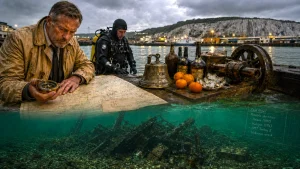
There are places that suit a conversation before a word is spoken. Cullins Yard is one of them. Tucked beside Dover Marina in an old converted shipyard, it is a place with history in the walls and memory hanging from the rafters. The restaurant describes itself as being full of original yard fixtures, wartime memorabilia and eye catching relics, and that is plain enough the moment you step inside. It feels less like a polished dining room and more like a corner of Dover where the past has refused to clear off quietly.
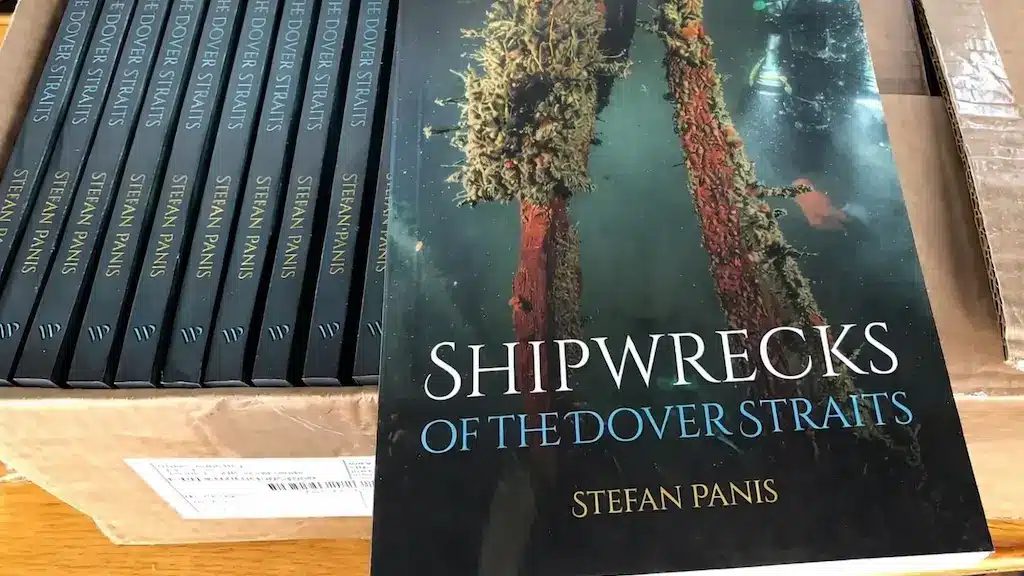
It is the right setting, then, to meet two men whose lives have been shaped by the waters beyond the windows. Chris Webb is known to many divers as the skipper of Maverick, a man whose knowledge of the Channel comes from long familiarity rather than romantic theory. Stefan Panis approaches the same stretch of water from another angle: technical diver, underwater photographer, researcher, and the author of Shipwrecks of the Dover Straits, published by Whittles in April 2024. The book runs to 208 pages, is richly illustrated in colour, and has been widely praised for combining diving narrative, photography, wreck history and archive material into something far more substantial than a simple list of sites.
And that, really, is where Webb and Panis meet. Webb knows the wreck as place. Panis knows the wreck as evidence. Webb puts divers where the story lies. Panis follows that story through silt, steel, timber, photographs, archives and objects. One brings people safely to the threshold. The other tries to work out what, exactly, they are looking at once they arrive. Between them is a shared respect for the wreck not as a playground, but as the remains of an event, sometimes of a catastrophe, always of a real voyage lived by real people
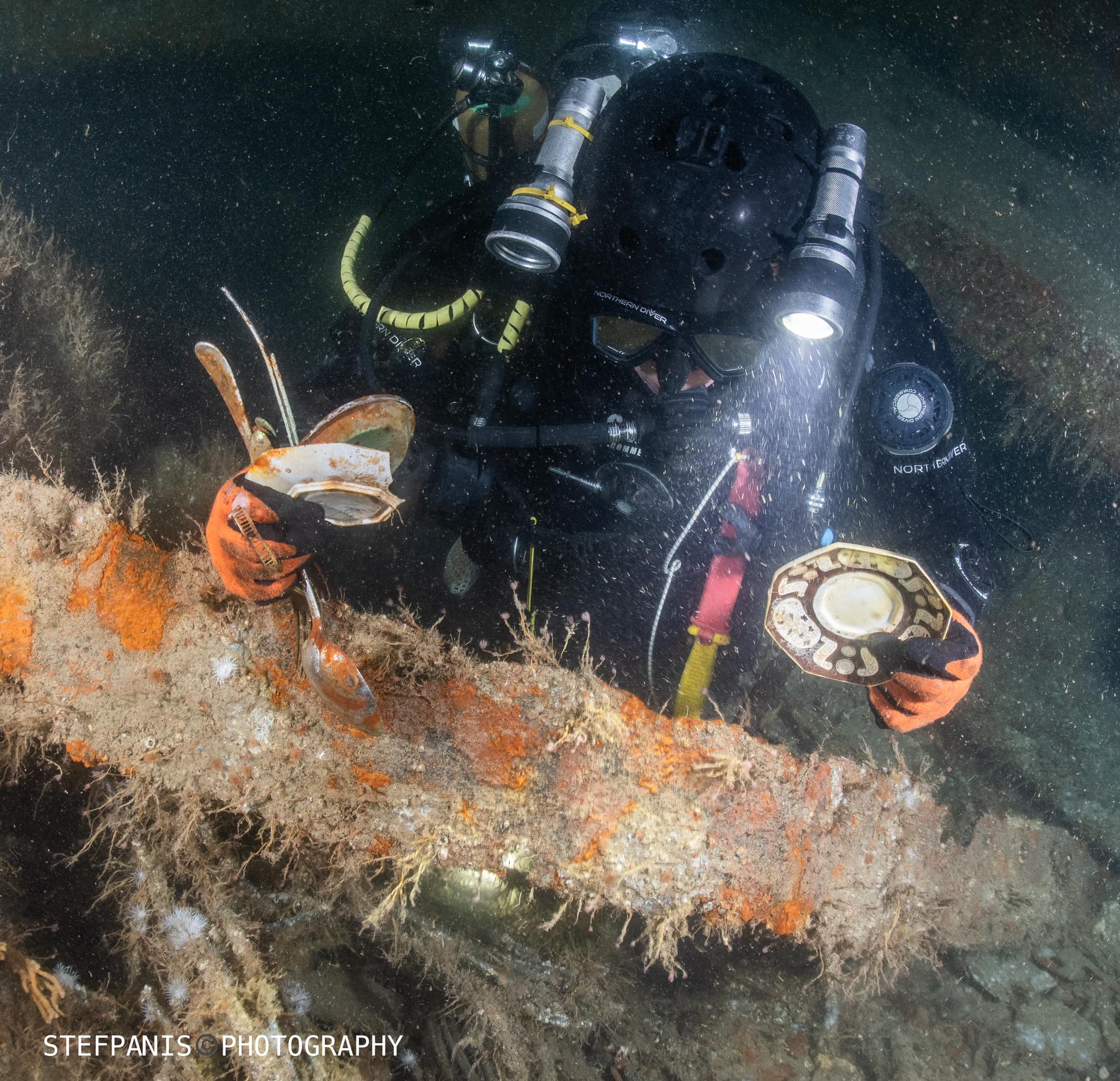
Sitting in Cullins Yard, surrounded by old objects and the suggestion of older trades, the conversation naturally drifts beyond diving and into memory. Why do wrecks matter so much to the people who keep returning to them? Because they are one of the few places where history is still physical. On land, the past is often flattened into plaques, dates and neat museum labels. Underwater, it is messier than that. A name on a casualty list becomes a boot, a bottle, a section of plating, a cargo fitting, a shape half-seen in poor visibility. The distance between then and now narrows. Panis’s book appears to understand that instinctively. The Marine Society description highlights not only the wrecks themselves but also the “actual dive” and the excitement of discovering age-old artefacts in challenging waters.

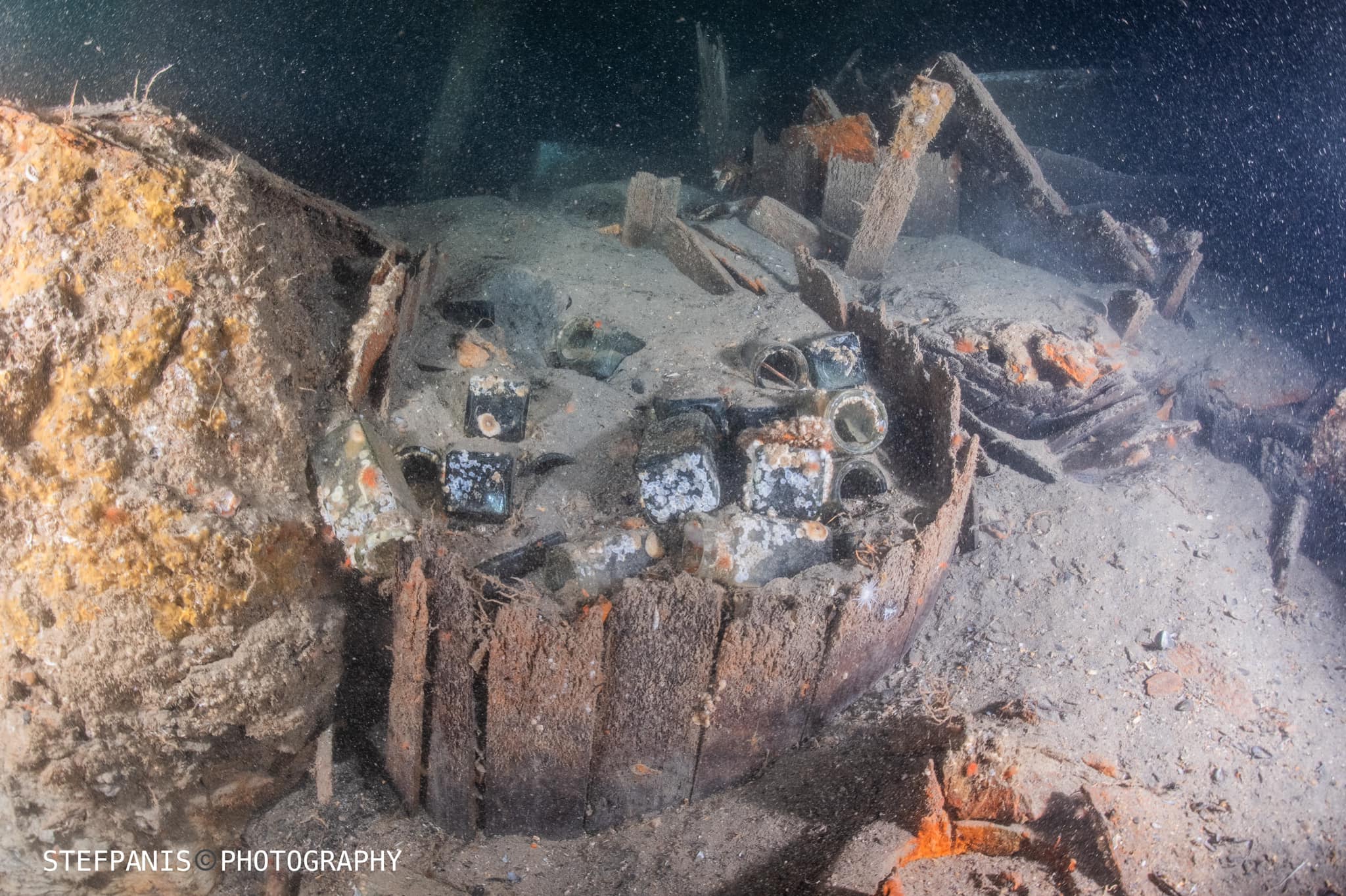
There is also something refreshingly unpretentious about a project like this. The Dover Strait is one of the busiest seaways in the world, yet so much of what lies beneath it passes unnoticed by the public. Ships move overhead. Ferries come and go. Freight thunders through. Tourists look at the White Cliffs and think of crossings, wars and homecomings. Beneath all that movement rests another Dover, one built of losses, collisions, mined ships, torpedoed hulls, scattered cargoes and forgotten names. Books like this do not invent that hidden world. They simply force us to look at it properly
What follows is not a transcript in the strict sense. It is better understood as a magazine-style encounter, shaped by the spirit of the setting, the character of the two men, and the published record of Panis’s work. That matters, because the subject deserves more than brochure copy. The Dover Strait is not a neat subject. It is crowded, brutal, layered and often murky in every possible sense. Any honest account of its wrecks must carry some of that weight.
Webb gives the conversation its local gravity. He knows, in the way only a working skipper can know, that the Channel is not impressed by enthusiasm. It does not care how many books have been written about it. It does not hand over visibility because somebody has travelled a long way, or because a diver has high hopes and expensive kit. These are hard waters, busy waters, and often cold, awkward and uncooperative ones. Every wreck here sits under tide, traffic, weather and time. To dive them at all is one thing. To understand them is another.
Panis, for his part, has built a reputation precisely because he tries to do both. Published profiles and reviews describe him as a highly experienced Belgian technical diver with specialist knowledge of wrecks in the North Sea and Dover Straits. His book has been commended as a vivid and highly pictorial account of expeditions onto merchant and military wrecks, one that brings together underwater imagery, recovered artefacts and the historical record in a way that makes each wreck feel inhabited again by its own past.
That is perhaps the first thing that strikes you when discussing the book in company like this: it does not treat wrecks as anonymous lumps of iron to be ticked off a slate. It gives them character. One vessel is remembered through a broken fitting, another through a page of newspaper reporting, another through a photograph that catches the strange dignity of a structure left on the seabed for decades. Reviewers have noted this quality repeatedly, calling the book both an enticing introduction to the Dover Straits and a vivid slice of maritime history brought to life.
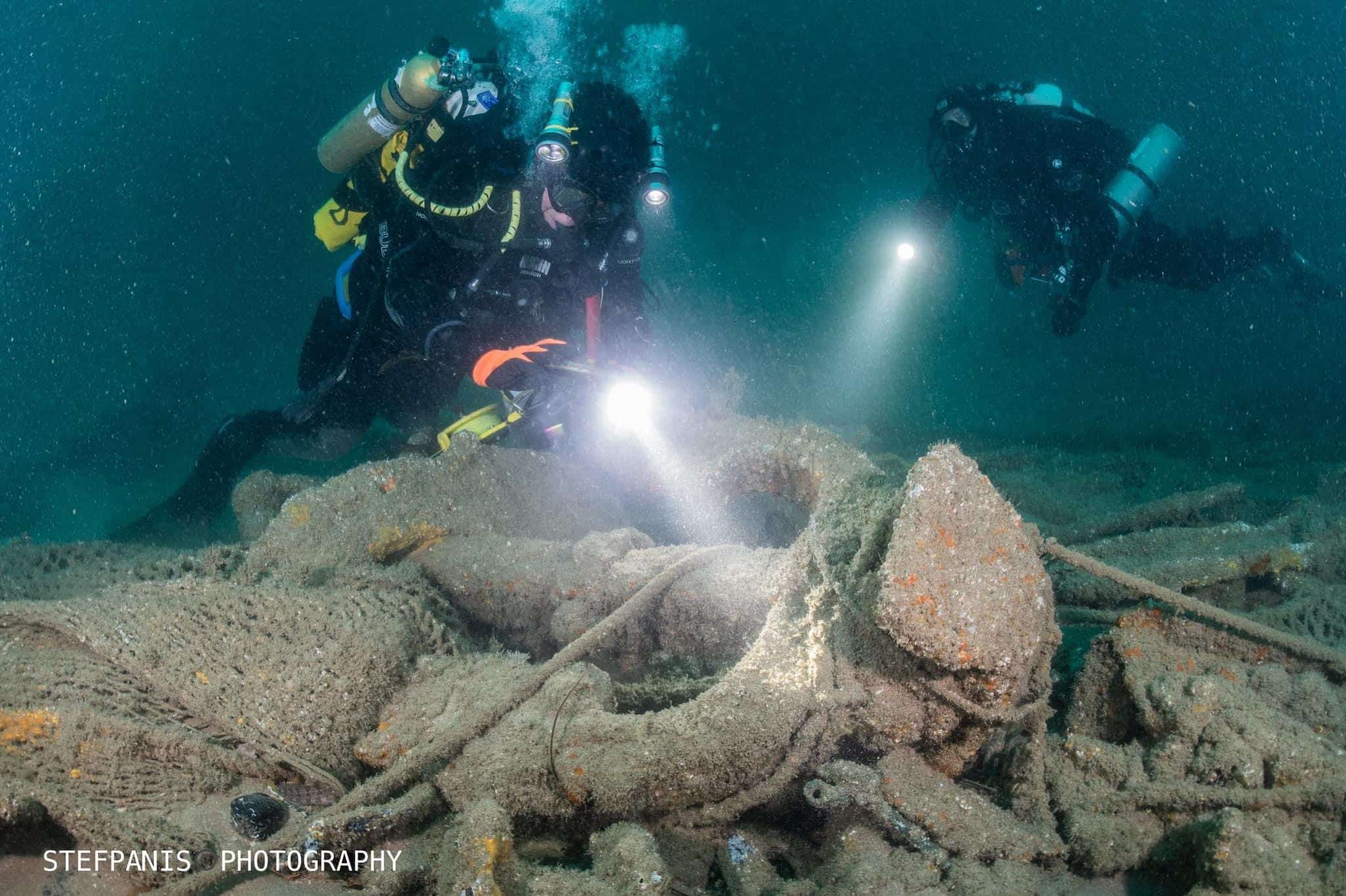


If Webb represents the practical soul of Channel wreck diving, then Panis gives it a form that can travel beyond the boat and beyond the day. That may be why the book has landed so well. British Diver called it a fantastic starting point for anyone who has looked out to sea and wondered what stories lie offshore. Other reviews have praised it as a valuable reference and a highly pictorial retelling of dive expeditions in the Dover Straits. It appeals because it understands that wreck-diving is never only about depth, shot position or bottom time. It is also about curiosity, patience, and the stubborn refusal to let a wreck remain mute when there is still something left to learn from it.
As the light fades outside and the marina settles into evening, Cullins Yard feels even more like the proper place for such a meeting. It is rooted in Dover’s working life, not some sanitised postcard version of it. The same can be said of the men at the table. Webb speaks from experience earned at sea. Panis writes from experience earned underwater and in the archive. Together, they represent two sides of the same enterprise: finding the wreck, and then finding its meaning
That is why Shipwrecks of the Dover Straits deserves attention. Not because it is glossy, though it is richly illustrated. Not because it flatters the reader with tidy adventure, though there is adventure in it. It deserves attention because it respects the wrecks enough to treat them as more than destinations. Each one is a witness. Each one has a history. Each one lies in darkness while the shipping still passes overhead, carrying on as though nothing happened. But something did happen, and the sea has kept the evidence.
In Dover, that truth is never very far away. You can hear it in the harbour. You can see it in the relics hung on pub walls. You can sense it in the way local divers and skippers talk about the water, with affection, yes, but never with complacency. And in Stefan Panis’s book, helped by the sort of local knowledge Chris Webb has spent years living rather than performing, those drowned stories are hauled a little closer to the surface.
For divers, that is reason enough to read it. For everyone else, it is a reminder of something easy to forget in a place as busy as the Channel: beneath the tide, the past is still there, waiting.
This feature is written in magazine style, inspired by the setting, the published record of Stefan Panis’s book and background, and the Dover wreck diving world.