
Some wrecks arrive in history with gunfire, explosions and grand naval drama. Hydaspes did not. She slipped into disaster in a bank of Channel fog, with whistles sounding, men straining to listen, and two vessels trying to work out where the other one was. A very Victorian accident, in other words. Lots of iron, plenty of confidence, and visibility reduced to the thickness of pea soup. Humanity, once again, taking a complex situation and adding a timetable.
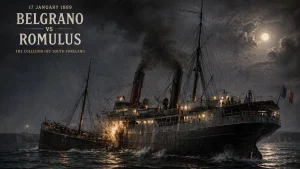
Hydaspes was lost off Dungeness on 17 July 1880 after colliding with the British steamship Centurion. She was under tow by the steam tug Napoleon, bound from London to Melbourne with passengers, crew and cargo on board. The court of inquiry later found fault on both sides, though it spared the certificates of the men involved. Nobody died, which is a mercy. The ship herself was not so lucky. [+]
A ship with two lives
Hydaspes is a lovely example of a vessel whose working life changed with the age she lived through.
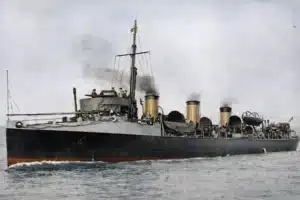
She began life in 1852 as an iron screw steamer, built by Charles John Mare & Co. at Blackwall and Northfleet. Her first owner was the General Screw Steam Shipping Company, one of those ambitious mid-Victorian ventures trying to prove steam could conquer the long ocean routes that sail had dominated for centuries. [+]
The available shipbuilding records list her as an iron screw steamer of 1,871 gross tons and 1,361 net tons, with a length of 246.5 ft, beam of 37.3 ft, and depth of 25.3 ft. In modern measurements, that is roughly 75.1 metres long, 11.4 metres wide, and 7.7 metres deep. She carried a 300 horsepower single-screw engine. By 1870, however, she was listed as a sailing ship.
That conversion matters.
By the time she was lost in 1880, the official inquiry described her as an iron sailing ship of 2,092 tons net register. So Hydaspes had crossed the line from steam pioneer to large ocean-going sailing ship. It was not unusual. Early steam machinery consumed space, coal and money. As steam technology moved quickly, some older screw steamers found a second life under canvas. The Victorians rarely threw away a useful hull. They preferred to repurpose it, insure it, reload it and send it back out into the Channel.
Build data
| Detail | Information |
|---|---|
| Name | Hydaspes |
| Type at build | Iron screw steamer |
| Type at loss | Iron sailing ship |
| Built | 1852 |
| Builder | Charles John Mare & Co., Blackwall and Northfleet |
| First owner | General Screw Steam Shipping Company |
| Port of registry | London |
| Official number | 25134 |
| Original tonnage | 1,871 GRT, 1,361 NRT |
| Inquiry tonnage at loss | 2,092 tons net register |
| Length | 246.5 ft, about 75.1 m |
| Beam | 37.3 ft, about 11.4 m |
| Depth | 25.3 ft, about 7.7 m |
| Original machinery | 300 hp, single screw |
| Later status | Listed as a sailing ship by 1870 |
| Final voyage | London to Melbourne |
| Date lost | 17 July 1880 |
| Cause of loss | Collision with SS Centurion in fog off Dungeness |
Sources disagree slightly on tonnage. That is not unusual with older ships, especially one converted from steam to sail and then recorded in different registers. The shipbuilding database gives the original steamer figures, while the formal inquiry gives her tonnage as a sailing ship at the time of loss. Nautical paperwork, naturally, never misses a chance to make a simple story wear a false moustache.
The General Screw Steam Shipping Company
Hydaspes belonged originally to the General Screw Steam Shipping Company. This company was founded in 1848 and became part of the early push to use screw steamers on long-distance routes. It placed orders with C. J. Mare & Co. for several major ships, including Queen of the South, Lady Jocelyn, Indiana, Calcutta, Mauritius and Hydaspes. [+]
The company chased mail contracts and long-distance services to the Cape, India, Australia and elsewhere. It was an ambitious plan, but early ocean steam was expensive, thirsty and mechanically demanding. Coal consumption, breakdowns and disappointing cargo and passenger returns all hurt the business. [+]
Hydaspes also appears in records connected with the company’s wider imperial routes. A postal auction record notes mail carried by Hydaspes during the Cape Town and Indian Ocean contract period in 1853, while another contemporary report mentions Hydaspes in relation to transport service during the Crimean War period. [+]
After the General Screw Steam Shipping Company’s fortunes declined, Hydaspes passed through later ownership. Records show her sold in 1861 to the East India & London Shipping Company. Other records list J. W. Temple by 1870 and Park Brothers by 1875. By the late 1860s, she had been converted into a sailing ship.
Bound for Melbourne
On the morning of 17 July 1880, Hydaspes left Gravesend at 4.30 am.
She was bound for Melbourne. On board were 47 crew, 40 passengers and around 2,000 tons of cargo. The court record does not itemise that cargo beyond the broad figure, which is irritating but typical. It is recorded as cargo for Melbourne, and a modern UKHO-derived wreck listing describes it as “general and mixed goods”. That usually means exactly what it sounds like: a mixed commercial cargo rather than one clean, glamorous cargo of gold bars, champagne or haunted accordions.
Hydaspes was not sailing freely down Channel. She was under tow by the steam tug Napoleon. At 2.30 pm, Dover Pier bore north magnetic, between one and three-quarters of a mile away. Around 2.45 pm, the Trinity House pilot left her. She continued steering south-west by west, making around 6 to 7 knots. The weather was hazy, but visibility still allowed vessels to be seen from 3 to 4 miles away. The sea was smooth. The wind was light. The tide was running westward.
Then the Channel did what the Channel does.
At about 4.20 pm, the weather thickened. The tug was ordered to ease. By 4.30 pm, the fog had become dense. Napoleon was ordered to go dead slow, and Hydaspes was making only about 1.5 to 2 knots. From then on, Napoleon’s steam whistle and Hydaspes’ fog horn sounded alternately. [+]
Enter SS Centurion
Centurion was an iron screw steamship of 1,845 gross tons, built at Jarrow-on-Tyne in 1876. She had left Almeria in Spain on 10 July, bound for London. She carried 27 crew, around 700 tons of esparto grass in bales, and about 10 tons of ivory. Esparto grass was used in paper-making, among other things. Ivory, sadly, was exactly what it sounds like. Victorian trade had a talent for turning both nature and morality into cargo manifests.
At around 4.40 pm, a pilot named Mr Pott boarded Centurion near the Newcombe Buoy. The vessel was placed on an east-north-east course to make Dover Pier. Five minutes later, she entered a thick bank of fog and slowed. Soon afterwards, a faint whistle was heard on the port bow. The pilot ordered the helm ported. Another whistle and a fog horn followed. The helm was then hard-a-ported.
That decision became central to the inquiry.
By porting, Centurion’s head came round from east-north-east to about east by south. In plain English, she began to put herself across the likely track of vessels moving up and down Channel. In thick fog. Near Dungeness. With a tug and large ship somewhere ahead. A lesser species might have paused. We invented committees instead.
The collision
From Napoleon, the sound of Centurion’s whistle was first heard faintly on the starboard bow. Then it came closer. Then closer again.
Suddenly, Centurion appeared out of the fog on the tug’s starboard quarter, apparently heading about east by south and making directly for Hydaspes. The captain of Napoleon hailed Centurion to go astern full speed, warning her that he had a large vessel in tow. He also hailed Hydaspes to starboard her helm. The tow line was cast off.
Hydaspes heard the whistle, but faintly. She followed the order to cast off and starboard her helm.
It was too late.
Centurion came out of the fog and struck Hydaspes just abaft the fore rigging on the starboard side. The impact cut Hydaspes below the waterline. Centurion rebounded, then came alongside again. Crew and passengers climbed, scrambled or were hauled aboard Centurion. The master, chief mate and pilot of Hydaspes stayed with the ship at first, then escaped into the tug boat.
Very shortly afterwards, Hydaspes sank with everything still on board.
The tug Napoleon took off the passengers and remaining crew from Centurion and landed them at Dover that same evening. All 87 people from Hydaspes survived, using the inquiry’s count of 47 crew and 40 passengers. Other secondary summaries give 85 people, so for the article I would use the official inquiry figure and note the discrepancy only in source notes.
What caused the loss?
The formal inquiry sat at Westminster on 10, 11, 12 and 13 August 1880. The court considered the conduct of Hydaspes, Napoleon and Centurion, as well as the effect of Centurion’s deck cargo.
The court found that Centurion’s deck cargo of esparto grass did not interfere with her navigation and did not contribute to the casualty. It also found that both vessels had been proceeding at moderate and proper speed before they sighted each other.
The key finding was more subtle.
Hydaspes and Napoleon took proper action when they heard Centurion approaching. But Hydaspes should have shortened her tow line when the fog became thick enough for her to lose sight of the tug. That fault rested with the master of Hydaspes, though the court did not think it serious enough to affect his certificate.
Centurion’s pilot was also found at fault. The court said Centurion should not have ported her helm until she had made out the course of the approaching vessels. By porting and then hard-a-porting, she placed herself across the track of Channel traffic. The court treated this as an error of judgement rather than neglect, and did not recommend suspension of his certificate.
So the loss of Hydaspes came down to fog, distance, judgement and timing. Not one dramatic mistake. Several small ones. That is often how ships are lost.
The wreck today
Modern wreck listings identify a possible Hydaspes site at 50°55.476 N, 1°03.049 E, east-north-east of Dungeness. The listing gives a general seabed depth of around 27 metres, with the wreck rising several metres from the seabed. Survey notes describe the wreck as largely intact and partially buried, though earlier surveys gave varying measured lengths as the site was re-examined. [+]
The same listing records her cargo as general and mixed goods, and states that she sank within minutes after collision with Centurion while under tow in dense fog, en route from London to Melbourne. It gives the newspaper date as 23 July 1880, but the official inquiry confirms the casualty date as 17 July 1880.
For divers, Hydaspes is compelling because she is not a simple wartime wreck. She belongs to an earlier age. Iron hull. Steam origins. Sailing career. Passenger route. Emigrant-era movement. Channel towage. Fog. Collision. Inquiry.
There is plenty to look at, and plenty more to think about.
Why dive Hydaspes?
Hydaspes is a wreck with layers. She began as part of the early screw-steamer age, when British shipping firms were gambling on steam across the world’s long routes. She later became a sailing ship, still large, still valuable, still trusted for the run to Australia. Then she vanished in minutes off Dungeness, not through storm or war, but through the old Channel enemy: fog.
For a diver, that gives the site a different feel. You are not only visiting the remains of a wreck. You are visiting a moment when steam, sail, towage, pilotage and Victorian confidence all met in the same patch of water and got it wrong.
Hydaspes carried 40 passengers who expected Melbourne, not Dover. She carried 47 crew who had a working ship beneath them one minute and a sinking hull the next. She carried around 2,000 tons of cargo that never reached Australia. Everyone lived, but the voyage ended there.
And now, more than 140 years later, the remains lie in Channel water, waiting for divers who like their wrecks with a proper backstory. Not every shipwreck needs gunfire to be dramatic. Sometimes all it needs is fog, a whistle, and a decision made a few seconds too soon.