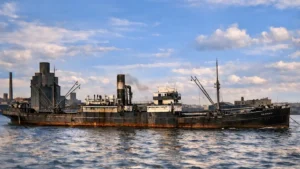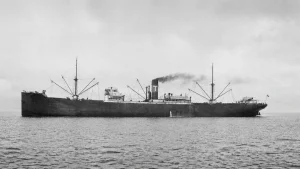

On 15 March 1916, the British steamship SS Shenandoah met a sudden and violent end in the English Channel, another quiet victim of the unseen threat that defined naval warfare in the First World War. She was a steel cargo steamer of 3,886 tons, typical of the hardworking merchant fleet that kept Britain supplied during wartime. Built in 1893 and operating out of Liverpool, she represented the dependable, unglamorous backbone of maritime trade.
At the time of her loss, Shenandoah was on passage from North America to London, carrying a general cargo through the busy and hazardous waters of the Channel. These routes, once routine, had become increasingly dangerous by 1916. German U-boats had shifted tactics, laying minefields in key shipping lanes. One such submarine, UC-6, had recently sown mines off Folkestone Gate, a narrow and heavily trafficked approach used by vessels entering the Thames and Channel ports.
Shenandoah struck one of these mines without warning. The explosion would have been catastrophic, tearing into the hull and leaving little time for an organised response. Despite the suddenness of the attack, most of the crew managed to abandon ship. Two lives were lost, a small number by wartime standards, though no less significant for it. Within a short time, the vessel slipped beneath the surface, joining the growing number of wrecks scattered across the seabed of the Channel.
Today, the wreck of SS Shenandoah lies as part of that underwater landscape, a silent record of the dangers faced by merchant seafarers during the war. Unlike more famous losses, her story is not widely told, and no confirmed photographs of the vessel have surfaced. What remains is a fragment of a much larger picture, one of ordinary ships caught in extraordinary circumstances.
For divers and historians alike, Shenandoah serves as a reminder that the war at sea was not only fought by warships. It was carried by cargo vessels, crews, and routine voyages that could, at any moment, turn into tragedy.