
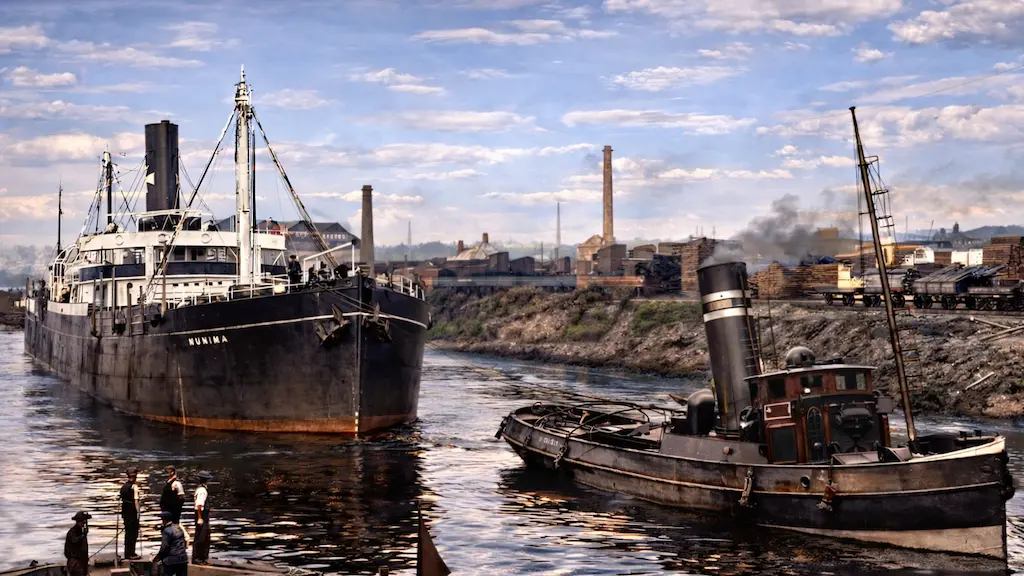
There are wrecks that announce themselves with violence, and there are those whose story sits more quietly on the seabed, waiting to be read properly. SS Nunima belongs to the latter. She was a British steel screw steamer built in 1903 by William Gray & Co. Ltd. of West Hartlepool, yard number 671, and completed in September 1903. At 2,938 gross tons and 1,881 net tons, measuring 325 ft by 47 ft by 22.4 ft, she was a substantial cargo steamer of the Edwardian period, powered by a three-cylinder triple-expansion engine of 287 nhp built by the Central Marine Engineering Works. Her official number was 115152.
The history of her name is refreshingly simple by Channel standards. The most reliable shipbuilding records list her as Nunima from build to loss, and I have found no verified earlier or later names for this vessel. At the time she was owned by Trechmann Bros., the same owners named in both shipbuilding and wreck records.
Her final voyage was a commercial one, but it ended in wartime conditions. On 4 January 1918, Nunima was on passage from Bilbao to Middlesbrough carrying a cargo of iron ore when she sank in the English Channel after a collision with an unidentified Royal Navy torpedo boat. Historic England records the loss approximately 6 miles south-south-west of Dungeness, and later hydrographic identification confirms the wreck as Nunima. This was not a torpedoing or mine strike. It appears to have been a wartime collision loss, accidental in immediate cause but unfolding in the pressured conditions of the First World War sea lanes.
As for lives lost, the public sources I could verify are frustratingly thin. I have not found a dependable casualty figure in the accessible records used here, so I am not going to dress that up with guesswork. The same caution applies to detailed survivor accounts. What is clear is the ship, the cargo, the route, the date, and the cause of loss.
For divers, the wreck itself is where Nunima becomes especially interesting. Hydrographic records describe her as lying upright on the seabed and fairly well intact, oriented roughly 040/220 degrees. The general seabed depth is given as about 31 metres, with the wreck rising significantly, and later survey notes record a least depth around 19.9 metres. Dimensions recorded in survey material give a wreck length of roughly 130 metres and width of 25 metres, which suggests either debris spread or survey envelope rather than neat hull dimensions, but the key point is that she still stands proud enough to make a proper dive of it.
The seabed appears to be relatively stable, with survey notes specifically stating no scour at the time of examination. Diver accounts describe her as an ore wreck with the deck encountered nearer 30 metres rather than the shallower figure sometimes repeated elsewhere, and visibility can be mixed, which will surprise nobody who has ever trusted the Channel to behave itself.
What makes Nunima special is the balance she offers between history and structure. She is not merely a name on a loss list. She is a clearly identified First World War cargo steamer, carrying a known cargo on a known route, lost in a known incident, and still lying upright enough to give divers a readable ship rather than a confused scrap field. That combination is rare enough. Add to it the quiet drama of a wartime collision, ore still associated with the wreck record, and a site that remains fairly intact, and you have a dive with real narrative weight.
Beneath the surface, Nunima is not a theatrical wreck. She does not need to be. She is a working steamer, outward bound from Spain with iron ore, stopped not by enemy shellfire but by a single catastrophic meeting in the Channel. More than a century later, she still lies there upright, her story plain enough for those willing to look properly.


