
There are wrecks that announce themselves with drama. There are wrecks that arrive with a thunderclap, a list of dead, and a national memory that refuses to fade. Then there is SS Mecklenburg.
She was not a battleship. She was not hunting submarines. She was not charging through history with flags snapping and guns blazing. She was a Dutch passenger and mail steamer. Her job was simple: carry people, post and cargo between Britain and the Netherlands.
On 27 February 1916, that ordinary job became a narrow escape from the hidden war beneath the North Sea. Mecklenburg struck a German mine near the Galloper Lightship while sailing from Tilbury to Vlissingen. Within half an hour, she had sunk. Yet every person aboard survived. The ship disappeared, but the people did not. That detail gives the story its strange shape. It is a disaster with no massacre, a wartime loss with no roll call of grief, a shipwreck that feels less like an ending and more like a file left open on a desk in a dimly lit room. [+]
And for divers, that makes her fascinating. Not because she is loud. Because she is not.
A Dutch ship in a dangerous sea
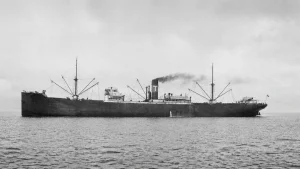
SS Mecklenburg belonged to Stoomvaart Maatschappij Zeeland, the Dutch Zeeland Steamship Company, based at Vlissingen. She worked the cross-Channel route between the Netherlands and England. This route connected Vlissingen with English ports, including Tilbury and Folkestone. It was a vital commercial and passenger link, one of those steady maritime services that kept moving while Europe was tearing itself to pieces.
She was built in 1909 by Fairfield Shipbuilding & Engineering Company Ltd at Govan, Glasgow. Uboat.net records her as a Dutch passenger steamer of 2,885 gross tons, built by Fairfield, and operated by the Zeeland company at Vlissingen. [+]
The Dutch MaSS maritime heritage record gives her dimensions as 106.6 metres long, 13 metres wide, with a draught of about 5 metres. That makes her a substantial ship for a passenger service of the period. She was not a little packet boat pottering across a calm pond. She was a proper steel steamer built for regular work in serious water.
There is a certain neatness to the ship’s purpose. She carried people. She carried mail. She carried routine. In wartime, routine becomes one of the first casualties.
The grey zone of neutrality
The Netherlands was neutral during the First World War. In theory, that neutrality should have protected Dutch shipping. In practice, the North Sea cared very little for legal theory. Mines did not stop to inspect paperwork. Submarines did not always wait for diplomatic clarity. A ship could be neutral, civilian and harmless, yet still become part of the war by being in the wrong square of sea at the wrong hour.
Captain Albert’s Holland America Line history makes the point plainly: Dutch ships suffered from mines and torpedoes during the war, despite Dutch neutrality. Mecklenburg was one of them. [+]
That is the cold truth beneath this story. Mecklenburg was not targeted because she was a warship. She was lost because the sea route had become a trap.
UC-7: the unseen hand
The mine that sank Mecklenburg had been laid by the German minelaying submarine UC-7. Uboat.net identifies UC-7 as a Type UC I minelaying submarine, built by Vulcan, Hamburg, launched on 6 July 1915, and commissioned on 9 July 1915. From 30 November 1915 to 5 July 1916, she was commanded by Georg Haag.
UC-7 was a small machine with a large shadow. Uboat.net credits her with 31 ships sunk, totalling 45,734 tons, plus two ships damaged and one warship sunk. She served with the Flanders Flotilla, operating from the German-held Belgian coast. Her weapon was not spectacle. It was patience.
A minelaying submarine did not need to face its victim. It seeded the water and left. The explosion came later, sometimes days later, when another captain, on another bridge, trusted a route that had already been compromised.
That is what happened to Mecklenburg. The hand that sank her was not visible from her deck. It had already withdrawn.
The final voyage
On 27 February 1916, Mecklenburg was sailing from Tilbury to Vlissingen. Uboat.net lists her route simply as Tilbury to Vlissingen, cargo as passengers, and the cause of loss as mined near the Galloper Light Vessel by UC-7.
The Dutch MaSS record gives more detail. It says Mecklenburg was on her way from Tilbury to Vlissingen when she struck a mine near the Galloper Lightship. The same source records 49 passengers and 75 crew aboard, a total of 124 people. It states she hit the mine at 11:46 and sank within half an hour. Half an hour. Long enough to understand what had happened. Short enough to leave little room for error.
You can imagine the scene without overcooking it. A passenger steamer making her way through wartime waters. Officers alert but bound by routine. Passengers perhaps uneasy, perhaps used to the warnings by then. The Galloper Lightship somewhere in the grey geography of the Thames approaches and the southern North Sea.
Then the mine. No grand naval duel. No warning shot. No visible enemy. A detonation from beneath. A ship’s life measured suddenly in minutes.
The Galloper Lightship
The Galloper Lightship marked dangerous waters off the Essex and Suffolk approaches, east of the Thames estuary. For vessels moving between Britain and the Low Countries, this was not some remote oceanic emptiness. It was a busy, watched, charted space.
That is what makes mine warfare so bleak. It turns known routes into suspicion. It makes a familiar sea behave like hostile territory.
By February 1916, the waters around the English east coast, the Thames approaches and the Dover Strait had become part of a wider concealed battlefield. Mines could be laid quickly by submarines and remain lethal after the submarine had gone. Ships then moved through a world where danger had no flag and no funnel smoke. Mecklenburg entered that world as a neutral steamer. She left it as a wreck.
The rescue
This is where the story turns. The ship was lost. The people were not.
The Dutch MaSS record states that all 49 passengers and 75 crew were rescued by three nearby ships: SS Westerdijk of the Holland America Line, Prins der Nederlanden of the Koninklijke West-Indische Maildienst, and Samarinda of Rotterdamsche Lloyd. Captain Albert’s account gives an additional rescue narrative. It says five steamships came to assist, three of them Dutch. It records that Westerdyk, Samarinda and Prins der Nederlanden were involved, and that passengers, crew and mail were taken off before Mecklenburg sank.
There are small differences in the numbers. MaSS gives 49 passengers and 75 crew. Captain Albert’s account mentions 46 passengers taken aboard Westerdyk, plus crew and mail, with other crew collected by Samarinda. That sort of discrepancy is common in wartime maritime records. It does not undo the central fact. The ship sank. Everyone survived. That is the part worth holding on to.
The mail was saved too
One detail deserves more attention. The mail was rescued.
Captain Albert’s account specifically states that Westerdyk took saved mail aboard, along with passengers, crew and Mecklenburg’s captain. It is a small human detail, but it matters.
Mailboats carried more than bags of paper. They carried business, family news, orders, invoices, rumours, condolences, love letters, bad news and worse news. In wartime, mail was the nervous system of civilian life. It crossed borders when people could not. It kept private lives connected while governments broke the map.
So yes, the mail being saved matters. A ship went down, but some of the words she carried still reached land. That is almost too neat for history, which usually prefers a mess.
A ship replaced, but not forgotten
The Zeeland company later built another Mecklenburg. Marhisdata records that a later Mecklenburg, launched in 1922, replaced the first vessel lost in February 1916. The later ship was built for the Vlissingen to Folkestone day service and was described as identical to the first Mecklenburg that had been lost during the war. [+]
That replacement tells its own story. Steamship companies did not trade in sentiment for long. Routes had to reopen. Timetables had to return. Passengers still needed crossings. Mail still had to move. So a new Mecklenburg took the old name. That is how maritime memory often works. A name disappears beneath the water, then returns painted on another bow.
The wreck today
The wreck of Mecklenburg sits as a physical reminder of that brief, violent interruption.
She was a sizeable vessel, over 100 metres long when built, and she sank in an area long associated with heavy traffic, mines, wartime losses and shifting seabed conditions. The MaSS record identifies her as a shipwreck of the world wars period near the Galloper Lightship. [+]
For divers, the attraction is clear. This is not a nameless scrap of iron. It is a named passenger steamer with a precise wartime story. It has a clear route, a known cause of loss, a known U-boat connection, and a rescue story strong enough to carry the whole article without melodrama. The wreck also sits in that interesting historical space between civilian service and total war. Mecklenburg was not built for combat. She became part of the war because minefields do not respect intention.
That gives the site a different mood from an armed trawler, destroyer or cargo ship loaded with munitions. It is quieter. More domestic. More unsettling.
Why dive SS Mecklenburg?
Some wreck dives are about machinery. Some are about depth. Some are about size, brass, guns, boilers or the pleasing chaos of a collapsed engine room. Mecklenburg offers something else. She gives you a story with layers.
First, there is the ship herself: a Dutch passenger and mail steamer, built in Glasgow, working a regular international route. Then there is the war: not the thunder of a fleet action, but the hidden pressure of mines laid in commercial waters. Then there is the rescue: nearby vessels closing in, passengers transferred, crew saved, mail recovered. Then there is the wreck: the physical remains of a ship whose sinking should have been a tragedy of lives lost, but instead became a rare survival story. That combination makes Mecklenburg a rewarding wreck for divers who want more than a GPS mark and a depth.
You are diving a moment. A neutral ship. A secret minefield. A sea route under suspicion. A captain with minutes to act. A rescue that worked.
A note on Gunther Plüschow
There is one odd footnote to Mecklenburg’s story. Uboat.net notes that Kapitänleutnant Gunther Plüschow, described there as the only German prisoner of war to escape Britain in either world war, made his escape across the Channel on Mecklenburg in July 1915.
That detail belongs to another story, but it gives Mecklenburg a faint intelligence-world aftertaste. Before she was sunk by a German mine, she had already played a small part in the strange traffic of wartime movement, identity and escape. It is the kind of footnote that feels as though it should have been written in a margin by a man who did not want to be overheard.
The enemy that waited
UC-7 did not survive the war either. Uboat.net records that UC-7 was lost on 5 July 1916, presumed to have blown up on a mine north of Zeebrugge while homebound. All 19 crew were lost. The bodies of some crew, including Georg Haag, were later recovered near the Dutch coast. [+]
There is a grim circularity to that. The submarine that laid mines in busy sea lanes was probably destroyed by a mine herself. No neat moral follows from it. The sea does not deal in morals. It keeps what it is given. But the detail sits there, cold and unavoidable. Mine warfare consumed the hunter as well as the hunted.
The historical importance of SS Mecklenburg
Mecklenburg matters because she shows how the First World War reached beyond battle fleets and trenches. She was a civilian ship. She served a neutral country. She carried passengers. She was engaged in ordinary work. Yet she was still lost.
Her sinking reminds us that the North Sea and Channel were not side notes to the war. They were active, dangerous theatres where commercial movement, naval strategy and civilian life overlapped every day. The fact that everyone survived should not make the sinking feel minor. It makes it unusual.
It also gives the wreck a rare atmosphere. Many First World War wrecks carry the weight of loss. Mecklenburg carries the weight of escape. That is different, but not lighter.
Diving the story, not only the steel
hen you descend on a wreck like Mecklenburg, you are not only visiting broken metal. You are entering a scene after the witnesses have left. The passengers are gone. The crew are gone. The rescuing ships have long since been broken up or forgotten. The Zeeland route changed. The war ended. The company replaced the ship. The records remained, scattered across Dutch maritime databases, U-boat listings and shipping histories, each one giving part of the account. The wreck is what remains when the paperwork stops talking.
That is why Mecklenburg is worth your attention. She is not the loudest wreck. She is not the most tragic. She is not the most famous. But she has that rare quality divers understand well: presence. You drop down expecting steel. You come back with a story.
Mutiny Diving angle
For Mutiny Diving, Mecklenburg sits beautifully among the more historically layered offshore wrecks.
She offers scale, date, identity and context. She also avoids the tired formula of “ship hits mine, ship sinks, many perish”. This one is different. The vessel was lost, but the people were saved. That makes the story easier to tell to a mixed group of divers without sanding away the seriousness.
It is a wreck with a strong briefing narrative:
- A Dutch steamer.
- A British-built ship.
- A neutral flag.
- A German mine.
- A hidden submarine.
- A half-hour sinking.
- A complete rescue.
- A wreck that still asks to be read properly.
That is more than enough for a memorable dive day.