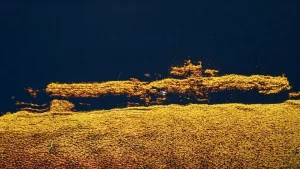

There are wrecks that announce themselves with certainty. They arrive with brass plates, Admiralty records, clean coordinates and the sort of tidy provenance that makes archivists smile into their tea.
Then there are wrecks like the Romulus.
For years, she seems to have drifted about in that half-world between local knowledge and formal record, known to divers off Kent, spoken of in the manner of old intelligence men discussing a vanished asset, quietly, cautiously, with one eye on the door. She was there, certainly. The name persisted. But the paperwork, as paperwork often does, lagged behind the truth. Wreck databases failed to line up neatly. One Romulus appeared in the wrong sea. Another in the wrong era. The official record, meanwhile, sat in plain sight, waiting for someone patient enough to follow the number rather than the noise. That person was me. That number was 68908. The vessel was ROMULUS of Sunderland. And the register closes her story with admirable coldness: sunk, 17 January 1889.
She had been built in Sunderland in 1874 by J. L. Thompson & Sons, yard number 117, an iron screw steamer of 1,442 gross tons and 922 net tons, measuring 248.8 feet by 32.2 feet by 17.5 feet. She belonged first to J. H. W. Culliford & Co. and later to Culliford & Clark. By the late 1880s she was one more workaday merchant vessel in the ceaseless industrial traffic of the age, carrying the blunt necessities of empire and commerce, not romance. Coal. Coke. Bricks. The sort of cargo that built cities, dirtied lungs and left no songs behind it.
Her final voyage was outward-bound from Sunderland to Livorno, and there is something almost indecent in the ordinariness of that fact. A ship leaves. A crew settles into routine. Watches are kept. Engines turn. Smoke trails aft. Somewhere in the North Sea and down the Channel, men stamp their boots, curse the cold and think of land. Then the weather closes in, or the light fails, or another captain misjudges a bearing by the width of a cigarette paper, and the whole enterprise tips from routine into catastrophe. The Sunderland record states that on 17 January 1889, Romulus was sunk after a collision with the French steamship Belgrano when 3 miles SSE of Dover Pier Light. That puts the scene exactly where the divers would expect it to be, off South Foreland, in that hard-worked stretch of water between Dover and Folkestone where the Channel narrows and human error is never far from the surface.
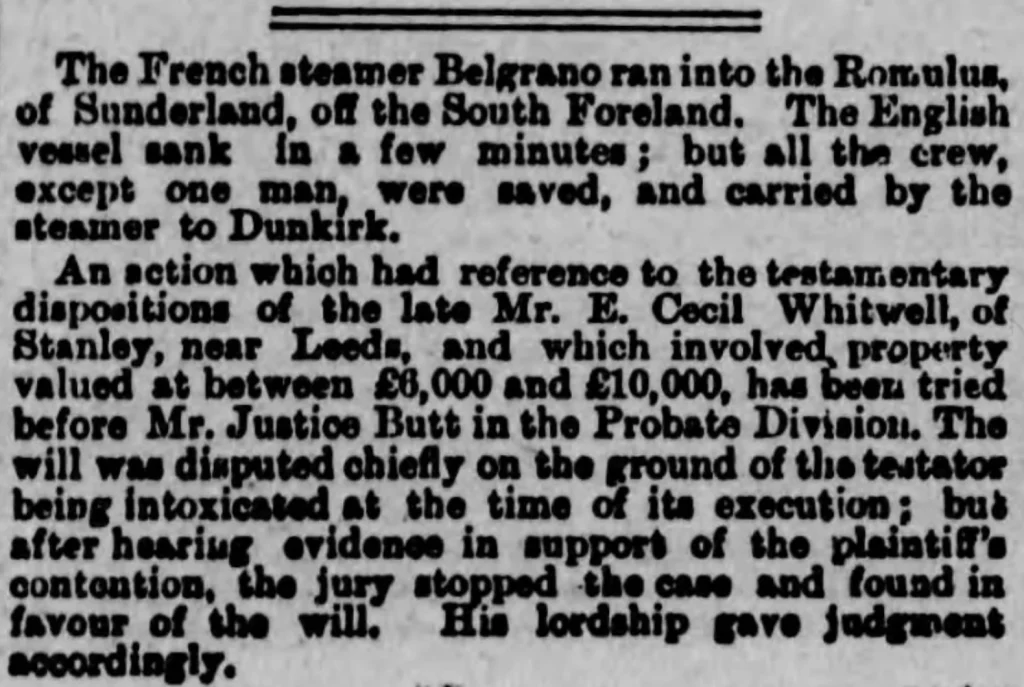
The collision itself comes to us in fragments, which is often the way with the dead. A local history extract preserving a report from the Liverpool Echo speaks of the “Sinking of the Steamer ROMULUS by collision” and places her off South Foreland. Another contemporary newspaper snippet, from the Basingstoke and North Hampshire Gazette, says that the French steamer Belgrano ran into the Romulus off the South Foreland, and that the English vessel sank within minutes. The Sunderland material adds a little more colour and a little more chill, stating that Romulus went down after the collision and that the rest of her people were landed at Dunkirk by Belgrano.
Between them, the sources sketch a scene of abrupt violence rather than prolonged struggle: darkness, impact, confusion, very little time, and the sea moving in to conclude matters with its usual lack of sentiment.
There is, too, the small matter of how truth arrives. An early press line appears to suggest that all the crew were saved. That was the first version, the convenient version, the sort of line telegraphed ashore before anyone had counted properly. Later evidence points another way. The Sunderland summary says plainly that a Romulus crew member named Anderson lost his life, while all the others were landed at Dunkirk by Belgrano. The Gazette snippet, though truncated, also hints that all were saved “except” one. This is how maritime history so often behaves: first a clean story, then a correction, then the faint residue of a human being left standing at the edge of the file. In this case, one name, Anderson, survives where many grander details do not.
That, perhaps, is the thing that brings the wreck into focus. Not the tonnage. Not the registry. Not even the impact. It is the loneliness of a single casualty in a working ship’s death. A naval disaster may carry speeches and memorials. A passenger liner may gather legends like driftwood. A Sunderland tramp steamer carrying fuel and building materials receives instead a clipped notice, a closure in the register, a newspaper paragraph, and one man not making it into the boat or onto the rescue deck. The rest are landed in France. The owner counts the loss. Commerce moves on. South Foreland keeps its weather. And the Romulus goes down into silence.
It is worth lingering on the French ship for a moment, because collisions are rarely solitary acts. Belgrano was no phantom. Period imagery appears to survive of her as a Chargeurs Réunis steamer, which gives the modern eye at least one fixed visual point in the case. She struck, survived, and carried the survivors to Dunkirk. In another history, with a different angle of impact, it might have been Belgrano on the bottom and Romulus limping away under borrowed mercy. But the Channel has always preferred arithmetic to justice. One hull gives way. One does not. The ledger is balanced.
For divers off Kent, that dry official story has a second life. The site has long been known locally as the Romulus, which now appears not to be folklore at all, but a remarkably faithful survival of the ship’s true identity. That matters. It means the name carried by charter skippers and passed from diver to diver was not the usual wreckside invention, nor a pub-born corruption repeated until it hardened into custom. It was, in all likelihood, correct from the beginning. The problem was not the divers. The problem was the paperwork around them, the missing entry here, the absent cross-reference there, the modern database that had somehow misplaced a Victorian casualty lying in plain historical view. The Crew List Index Project confirms the official number and the closure date. The Sunderland records confirm the builder, dimensions, owners and loss details. The newspaper traces confirm the collision off South Foreland. Piece by piece, the old steamer comes back out of the fog.
There is no confirmed period photograph of the Romulus herself that has surfaced so far. That feels apt. Some ships leave portraits. Others leave outlines. We have the particulars. We have the official number. We have the route, the cargo and the date. We have the colliding vessel and the place of loss. We have, with reasonable confidence, the name of the one man who did not come home. What we do not yet have is her face. So one is left to imagine her as she must have looked in those last minutes: a black-hulled Victorian steamer in winter dark, iron sides cold and wet, decks suddenly alive with shouted orders, the shock of collision travelling through plates and frames, a list beginning where no list had been expected, lamps swinging, steam hissing, and the South Foreland somewhere out in the murk, indifferent and unchanged.
And now, after more than a century, she waits again, though in a different capacity. Not as a cargo steamer pushing south with coal and coke, but as a wreck site off Kent, visited by divers who descend through green water into the aftermath of a January night in 1889. They will go down with GPS, cameras and reels. They will talk of depth, visibility and shot placement. They will note the shape of the wreck, the collapse of iron, the machinery still recognisable after all this time. Yet beneath the practical business of the dive lies the older story, still faintly audible if you listen for it: a Sunderland steamer, a French packet, a collision off South Foreland, a rescue to Dunkirk, one missing man, and a name that refused to die even when the records around it blurred.
That is the real fascination of the Romulus. She is not merely another broken hull on the Channel floor. She is a recovered identity. A ship that slipped through the administrative net but remained alive in local memory. A working steamer restored, at last, to herself.