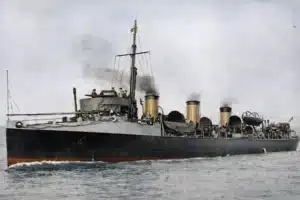

Some wrecks belong to the beginning of wars. They carry the first shock. The first newspaper panic. The first lists of missing men read aloud in kitchens and offices where nobody yet understands what the next few years will cost. SS Filleigh belongs to the other end.
She was lost on 18 April 1945, less than three weeks before Germany surrendered. By then, the war in Europe was entering its final, ugly corridor. Cities were falling. Armies were collapsing. Men who had survived years at sea could see the end approaching. And still, in the grey water off North Foreland, a German U-boat waited. [+]
Filleigh was a British steam merchant ship, built in Sunderland in 1928. On her final voyage, she was sailing from London to Antwerp in Convoy TAM-142, carrying 6,000 tons of military cargo. At 05:55 on 18 April 1945, she was hit and sunk by U-245, commanded by Friedrich Schumann-Hindenberg. Five men died. Forty-nine survived. The survivors were landed at Dover.
It is the timing that catches you. April 1945. The war nearly over. The danger not quite finished. History has a miserable talent for taking men at the threshold.
A Sunderland-built merchant ship
SS Filleigh was completed in October 1928 by William Pickersgill & Sons Ltd of Sunderland. She was a British steam merchant ship of 4,856 gross tons, owned by W. J. Tatem Ltd of Cardiff, with London listed as her home port. She was not glamorous. She was not famous. She was one of the working ships that made war possible.
Ships like Filleigh moved coal, food, equipment, stores, troops’ supplies and the endless practical clutter of military life. They did not decide campaigns, at least not in the way politicians and generals liked to imagine campaigns being decided. They fed them. They clothed them. They armed them. They kept the war moving. That made them targets.
A merchant ship in wartime often looked ordinary from a distance. A funnel. A bridge. Holds. Derricks. A working deck. Men doing skilled, dangerous jobs while the world pretended civilian labour and war labour were separate things. They were not. By 1945, a ship carrying military cargo to Antwerp was part of the Allied advance. Filleigh was not simply steaming from one port to another. She was feeding the final machinery of the war.
The route: London to Antwerp
Filleigh’s final route was London to Antwerp. That detail matters. Antwerp had become one of the most important Allied supply ports after its liberation, although access to it depended on clearing and controlling the Scheldt approaches. By April 1945, traffic into the Low Countries formed part of the huge Allied supply effort on the European mainland.
Filleigh sailed in Convoy TAM-142. The Arnold Hague convoy database records that the TAM convoy series ran from Southend to Antwerp between December 1944 and May 1945. It also lists the series as containing 172 convoys, 1,626 ship entries and 35 escort duties.
That gives Filleigh’s voyage its wider frame. She was not alone. She was one small unit in a controlled stream of shipping crossing dangerous water at the end of the war. Convoys reduced risk, but they did not remove it. The escorts, routes, signals and formation orders all existed because the threat still existed. The sea off Kent had not become safe simply because Berlin was failing. The mines were still there. The U-boats were still there. And men still had to go.
U-245: the late-war predator
The submarine that sank Filleigh was U-245, a German Type VIIC U-boat. Uboat.net records that she was ordered in 1941, laid down at Friedrich Krupp Germaniawerft AG, Kiel, launched on 25 November 1943, and commissioned on 18 December 1943 under Friedrich Schumann-Hindenberg.
U-245 made three patrols and sank three ships, totalling 17,087 GRT. Her final tally included Henry B. Plant, Filleigh, and the Norwegian merchant ship Karmt. She also had a Schnorchel, the underwater breathing apparatus that allowed late-war U-boats to run diesel engines while submerged. Uboat.net notes that U-245 was fitted with one in April 1944. That detail changes the feel of the story.
This was not the older U-boat war of long surface chases and proud deck-gun photographs. By 1945, the German submarine war had become darker, more technical and more desperate. The boats spent more time hidden. The commanders had fewer chances. The Allies had better aircraft, better radar, better escort tactics and better intelligence. Yet a hidden U-boat still needed only one chance. On 18 April 1945, U-245 found one.
The attack on Convoy TAM-142
At 05:55 on 18 April 1945, U-245 attacked Convoy TAM-142 about 10 miles east-south-east of North Foreland. Uboat.net records that the submarine claimed two steamers and also fired a Gnat acoustic torpedo at a corvette. The recorded result was that only Filleigh and Karmt were hit and sunk.
The convoy page for TAM-142 also lists the two ships lost that day: Filleigh, 4,856 tons, and Karmt, 4,991 tons. Together, the two losses totalled 9,847 tons. The position given for Filleigh is 51°20’N, 1°42’E, in naval grid AN 7968. There is something cold about those numbers. A time. A bearing. A grid square. A tonnage figure. A ship reduced to an entry.
But that is how sea war often survives in the record. The blast itself vanishes. The noise goes. The men are rescued or not. The wreck settles. Then the paperwork arrives, dry and exact, as if it had been there first.
Five men lost
Filleigh had a complement of 54. Uboat.net records five dead and 49 survivors. The survivors included the master, Patrick McSweeney, along with 37 crew members, ten gunners and a Belgian pilot. They were picked up by a British escort vessel and landed at Dover.
Uboat.net’s crew listing names six people associated with the ship, including Master Patrick McSweeney and crew members Casper Alphonso Blackman, William Newman, Peter Mathias Simmonds, George Kojo Torkornoo and Yasat Matsih. Those names are worth keeping in the story.
Wreck write-ups often fall into the lazy habit of speaking only about steel. Steel is easier. Steel does not have relatives. Steel does not have handwriting, debts, bad jokes, sore hands, or a favourite chair at home. But wrecks are human sites first. Filleigh was a ship, yes. She was also a workplace. On 18 April 1945, it became a casualty scene. Five men did not come back.
A war nearly over, but not finished
The loss of Filleigh sits in a cruel little pocket of time. By mid-April 1945, the German war effort was collapsing. The Red Army was closing on Berlin. Allied forces were deep inside Germany. The end was visible. Yet the U-boat war still had teeth.
U-245 survived the attack on TAM-142. She later surrendered at Bergen, Norway, on 9 May 1945, the day after Victory in Europe Day in Britain. She was transferred to Loch Ryan and later sunk during Operation Deadlight on 7 December 1945.
That creates a sharp line through the story. Filleigh went down on 18 April. U-245 surrendered on 9 May. Twenty-one days. A lifetime if you are on the wrong ship.
This is why late-war wrecks often feel different. They do not carry the shock of the unknown. They carry the bitterness of the almost. Almost home. Almost peace. Almost through. Then the torpedo arrives.
The other ship: Karmt
Filleigh was not the only vessel lost in the attack. The Norwegian merchant ship Karmt was also sunk by U-245 in the same convoy action. Uboat.net lists both Filleigh and Karmt as ships hit from TAM-142 on 18 April 1945. [+] [+]
This matters for dive interpretation. When two ships go down in the same action, wreck identity and local storytelling can become tangled over time. Positions may vary by source. Survivors may report different bearings or sinking times. Later dive reports may favour one name over another depending on what was found, where the shot landed, or what someone had been told by someone who had been told by someone else in a harbour bar.
Humanity, naturally, invented charts and then seasoned them with hearsay. So Filleigh should be treated as part of a paired historical incident. She and Karmt belong to the same attack, the same convoy, and the same late-war moment off North Foreland.
What the wreck represents
Filleigh’s wreck is more than a torpedoed cargo ship. It marks a phase of the war when the U-boat campaign had lost its strategic dominance but could still kill. It marks the vulnerability of supply traffic into liberated Europe. It marks the courage and routine endurance of the Merchant Navy. It also marks Dover’s connection to the story.
The survivors were landed at Dover after rescue. That places the loss within the wider Dover Strait wartime landscape, the same geography of convoys, escorts, mines, aircraft, patrol vessels and merchantmen that shaped the coast throughout both world wars.
For a diving audience, that connection matters. You are not dealing with some distant Atlantic episode. You are dealing with a ship lost in the approaches off Kent, during a convoy passage to Antwerp, with survivors brought ashore at Dover. That makes the story local enough to feel close. And dark enough to deserve care.
Diving SS Filleigh
As a dive, Filleigh offers the appeal of a named Second World War merchant wreck with a strong historical identity. The essentials are clear:
- She was British.
- She was Sunderland-built.
- She was carrying military cargo.
- She was in convoy.
- She was sunk by a known U-boat.
The date, attacker, commander, route, cargo, casualty numbers and survivor landing point are all recorded. That gives a dive briefing real weight. This is not “a wreck somewhere off Kent”. It is SS Filleigh, lost in the final weeks of the war. For divers, her story carries three strong hooks.
First, she has scale. At 4,856 gross tons, she was a substantial steam merchant ship. Second, she has context. She was sailing in Convoy TAM-142, part of the Southend to Antwerp convoy system that operated in the last months of the war. [+] Third, she has atmosphere. A late-war U-boat attack. A military cargo. A rescue. Five lost men. Dover receiving the survivors. Peace close enough to see, but not close enough to save everyone.
That is strong material for a proper wreck dive. Not cheerful. Not neat. But memorable.
The ship as evidence
A wreck like Filleigh works almost like a file from an old ministry archive. You have the ship’s particulars. You have the convoy number. You have the attack time. You have the U-boat. You have the commander. You have the cargo. You have the survivors. You have the dead. What you do not have is the full human sound of it. The engines stopping. The first list of names. The wet clothes. The exhausted men on the escort vessel. The harbour at Dover receiving survivors from a war everyone wanted finished. That is where the diver’s imagination has to behave itself. You do not need to invent melodrama. The facts already carry it. The trick is to stand back and let them speak.
Mutiny Diving angle
For Mutiny Diving, Filleigh is an excellent event-page wreck because the story is clean, local and powerful. She gives you:
- A named Second World War merchant ship.
- A clear sinking date: 18 April 1945.
- A known attacker: U-245.
- A known convoy: TAM-142.
- A known route: London to Antwerp.
- A military cargo of 6,000 tons.
- Five men lost.
- Survivors landed at Dover.
That is a strong briefing before anyone even reaches the shot line. It also gives the dive emotional shape. You can present Filleigh as a serious offshore wreck with a late-war story, rather than another anonymous lump of steel where the boilers are interesting and the past is treated as optional furniture. The past is not optional here. It is the point.
A note on source discrepancies
The main details used here come from Uboat.net and the Arnold Hague convoy database.
One useful caution: some secondary references confuse or mistype the attacking U-boat. The Arnold Hague convoy page snippet visible in search results appears to list Filleigh as “sunk by U 425”, while the detailed Uboat.net ship page, U-245 page and TAM-142 page identify U-245 as the attacker. The stronger reading is U-245, commanded by Friedrich Schumann-Hindenberg.
This is exactly why shipwreck research should never rely on one line in one list. One digit goes wandering and suddenly a U-boat has an alibi. Splendid work, paperwork.