Neap Tide
Neap Tide marker for general dive planning around Dover. Use as guidance only. Final dive timings depend on skipper judgement, weather, sea state, tidal data and site conditions.
Neap Tide marker for general dive planning around Dover. Use as guidance only. Final dive timings depend on skipper judgement, weather, sea state, tidal data and site conditions.

On 24 May 1953, Andaman collided with the Panamanian steamer Fortune about 3 miles south of the South Goodwin Lightvessel. She began sinking, and her 38 crew abandoned ship into two boats. The Dover lifeboat launched, but the crew had already been picked up by the SS Arthur Wright, before being transferred to the lifeboat and landed at Dover. No lives were lost. For divers, Andaman is a fine post-war Channel wreck: a substantial Swedish cargo ship, lost in fog near the Goodwins, with a clean rescue story and enough size, structure and atmosphere to make her far more than a name on a chart.

On 9 March 1900, Cuvier was struck on the starboard side in the Dover Strait by the Norwegian steamer Dovre, which was bound from Burntisland to Dieppe with coal. The collision tore open her side, flooded the engine room, and she sank in minutes, around 6 miles east of the East Goodwin Lightvessel. Historic England records heavy loss of life, with sources giving 26 to 28 crew lost and only a handful of survivors picked up by the steamer Windsor. For divers, Cuvier is a classic Goodwins-area wreck: a Victorian cargo steamer, a sudden night collision, a grim human story, and a site known for recovered Maastricht-marked bowls, mugs, chamber pots, portholes and crockery. It’s the kind of wreck where the artefacts make the story feel oddly domestic, which somehow makes the tragedy hit harder.
These dives are for curious divers who like a bit of mystery with their slack water. The wreck may have been rarely dived, poorly recorded, misidentified, or never properly explored. There may be no neat answer waiting on the shotline, which is half the fun and also the reason humans keep buying expensive torches and calling it a hobby. Look for clues: boilers, engines, winches, cargo, crockery, ballast, armament, construction details, anything that might help bring a lost name back from the seabed. You are not booking a routine wreck dive. You are joining a proper offshore puzzle, and the next clue might be yours.
These dives are for curious divers who like a bit of mystery with their slack water. The wreck may have been rarely dived, poorly recorded, misidentified, or never properly explored. There may be no neat answer waiting on the shotline, which is half the fun and also the reason humans keep buying expensive torches and calling it a hobby. Look for clues: boilers, engines, winches, cargo, crockery, ballast, armament, construction details, anything that might help bring a lost name back from the seabed. You are not booking a routine wreck dive. You are joining a proper offshore puzzle, and the next clue might be yours.

An evening at Cullins Yard with food, drink and good company, hosted by Mutiny Diving. Free buffet, with donations encouraged for the RNLI.

Her career was brutally short. On 28 November 1864, Mindora collided in the English Channel with the Khersonese, another outward-bound sailing ship, reportedly on passage from London to Calcutta. Contemporary shipwreck listings place the collision about 8 nautical miles south-west by west of South Foreland, with Mindora sinking and the other vessel abandoned in a sinking condition. For divers, this is a proper Victorian mystery wreck: a young barque lost almost as soon as her story began, a collision in one of the world’s busiest sea lanes, and a seabed site that still gives up small clues from a long-vanished age of sail.

On 3 December 1915, Étoile Polaire struck a mine and sank off the South Goodwins. The minefield is recorded as having been laid by the German minelaying submarine UC-1, commanded by Kapitänleutnant Egon von Werner. Her wreck has had a confusing afterlife: Canterbury Divers and Historic England both note that a site once listed as HMT Cayton Wyke was positively identified as Étoile Polaire when her bell was recovered. The wreck lies in about 27 metres, stands up to 5 metres proud, and is described as fairly intact, with a blown-off bow, open holds, intact stern and surviving superstructure. For divers, this is a cracking Dover Patrol wreck: compact, atmospheric, strongly identified, and close enough to the Goodwins to add that little pinch of "this place has been eating ships for centuries".
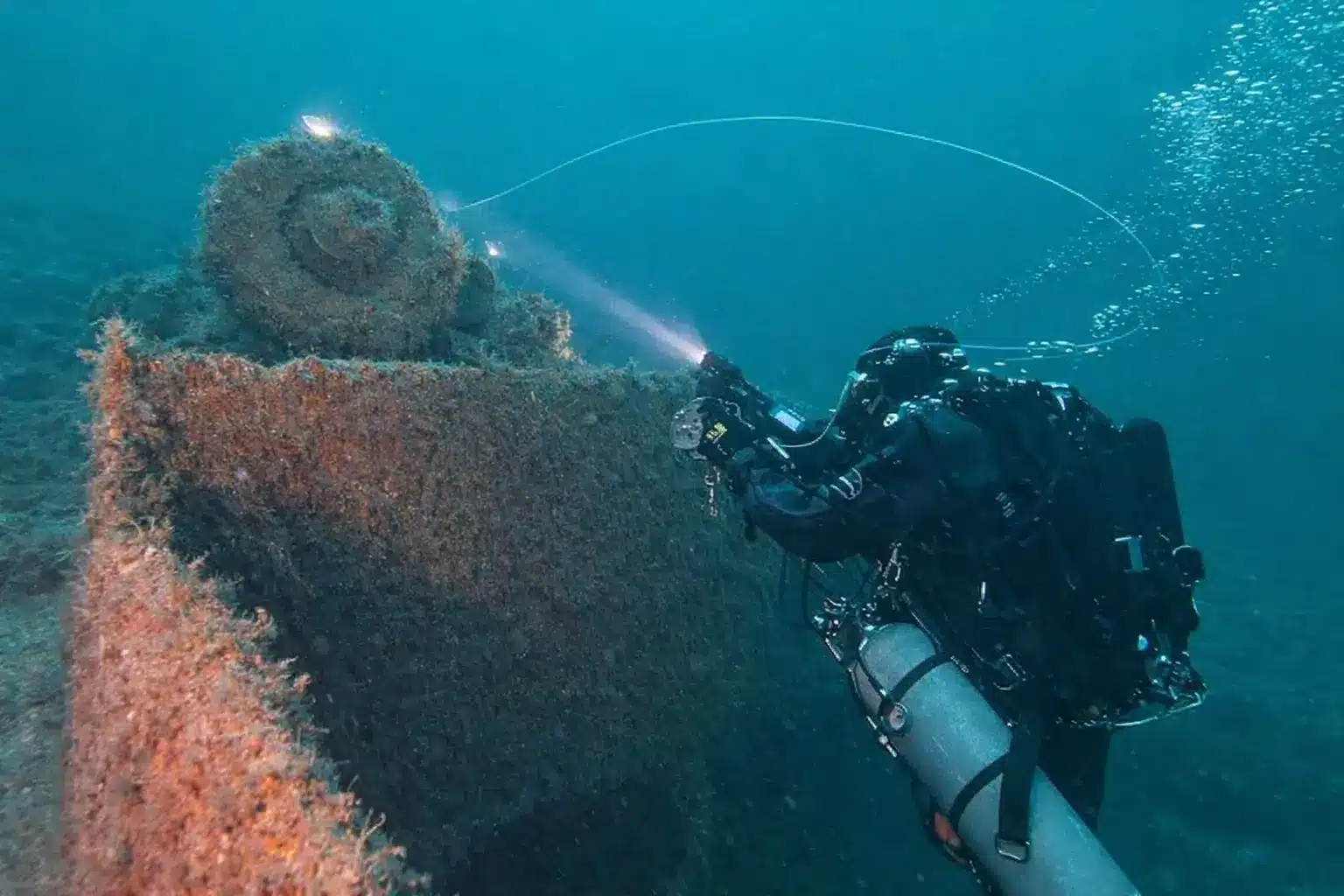
Close beside her lies the older Denbighshire, lost in 1887 and later identified by her recovered bell. Historic England notes her wreck lies close to Laristan, while Canterbury Divers describes the Denbighshire as sitting only about 10 metres from the bigger Laristan, in a maximum depth of about 31 metres, standing around 5 metres proud. For divers, the appeal is obvious: two Victorian wreck stories in one dive, one a cargo steamer loaded with iron ore, the other an earlier casualty close enough to turn the seabed into a historical puzzle. It is a cracking Dover site for anyone who likes machinery, structure and a little identity intrigue with their slack water.
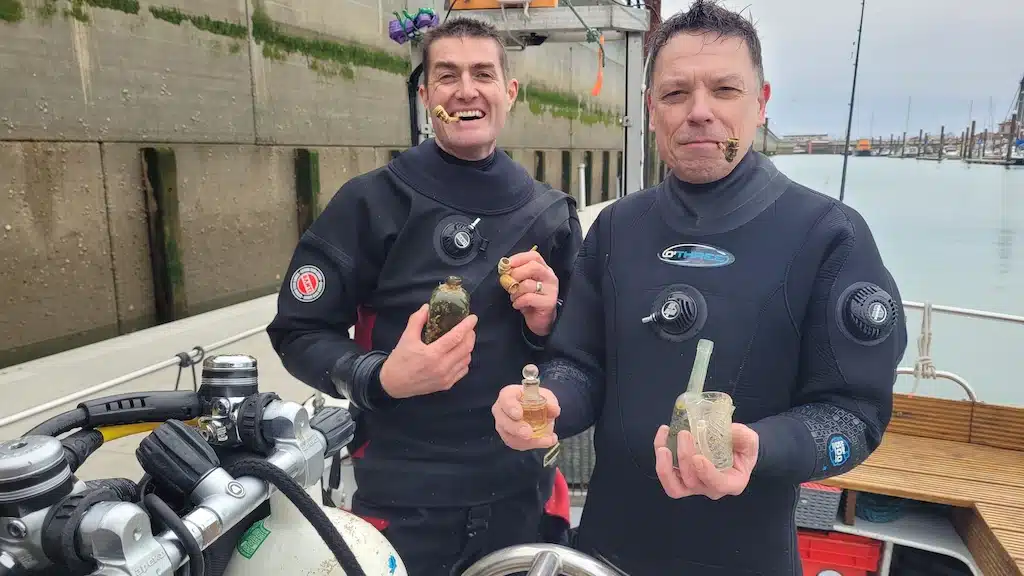
For divers, Loanda is one of those wrecks that rewards curiosity as much as good buoyancy. She lies upright in roughly 17 to 23 metres, standing several metres proud, with exposed engine remains, an intact propeller, and a cargo story worthy of a Victorian dockside whisper. Reports mention gin and champagne bottles, clay pipes, perfume bottles, trading beads, and the persistent tale of newly minted shillings, although the shilling story is not supported by the manifest. It’s shallow, atmospheric, artifact-rich and very much a slack-water dive, the kind of Dover wreck where every broken bottle and clay pipe feels like it has been waiting 116 years to be noticed.
Spring Tide marker for general dive planning around Dover. Use as guidance only. Final dive timings depend on skipper judgement, weather, sea state, tidal data and site conditions.
Neap Tide marker for general dive planning around Dover. Use as guidance only. Final dive timings depend on skipper judgement, weather, sea state, tidal data and site conditions.