
G-85: the German large torpedo boat sunk off Dover
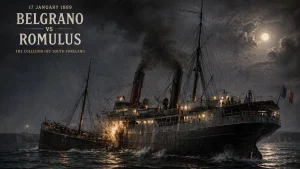
G-85 was a German large torpedo boat sunk in the Dover Strait during the Second Battle of Dover Strait, fought overnight on 20–21 April 1917. The Flanders-based German force had come out to attack the Dover Barrage and bombard targets around Dover and Calais. British leaders HMS Swift and HMS Broke intercepted the raiders near the Dover Strait and Goodwin Sands area. HMS Swift is commonly credited with torpedoing G-85; HMS Broke was heavily involved in the same fight and rammed a different German boat, G-42.
For divers and Channel historians, G-85 matters because it is part of the long, awkward story of the Dover Patrol, the barrage, and the narrow sea that both sides needed and hated. It should not be treated as a cheerful collectables tale. Men died aboard her, and any associated site belongs in the category of serious military loss, not souvenir shopping.
G-85 and the Flanders torpedo boat war
G-85 belonged to Germany’s large torpedo boat fleet, or Großes Torpedoboot. That term matters, because it does not mean a small later-style motor torpedo boat. In Imperial German Navy use, a Großes Torpedoboot was a seagoing torpedo craft broadly comparable to what many other navies called a destroyer, though German terminology kept the traditional torpedo boat label.
These ships were intended primarily as offensive torpedo carriers, with enough seaworthiness to operate beyond harbour waters and with guns for defence and surface fighting. By G-85’s generation they were serious warships, not little speedboats with ambitions. From bases in occupied Flanders, such boats raided Channel traffic, laid mines, attacked patrol craft, and tested the Dover Barrage. Their work was cold, cramped, and often brief.
The Dover Patrol’s job was equally unglamorous: keep the Strait difficult for U-boats and surface raiders, protect cross-Channel movements, and make life generally tiresome for anyone flying the wrong ensign. By 1917, that meant patrols, drifters, nets, mines, searchlights, and a great deal of night-time uncertainty.
The Dover Strait in April 1917
The Strait was not merely a gap between headlands. It was the squeeze point of the southern North Sea war, where merchant routes, patrol lines, mines, sandbanks, tide, and weather collided. The Goodwin Sands area, familiar to Kent divers for reasons both scenic and mildly vindictive, formed part of that tactical landscape.
The German sortie on the night of 20 April aimed to damage the Dover Barrage and shell military or port targets around Dover and Calais. These raids were not random vandalism. They were attempts to loosen British control of the narrow waters and embarrass a defensive system that absorbed men, ships, and patience.
The night action: Swift, Broke, G-85 and G-42
During the night of 20–21 April, HMS Swift and HMS Broke encountered the German torpedo boats in poor visibility and high confusion, which is naval history’s polite way of saying that everyone was moving fast, armed, and not entirely sure who was where. The British ships pressed in aggressively.
G-42 and G-85 were the two German losses most easily muddled in retellings. HMS Broke rammed G-42, leading to savage close-quarter fighting. G-85, separately, was torpedoed, with HMS Swift usually credited for the hit. Keeping the boats separate matters: otherwise the story becomes a Channel-sized drawer of unmatched bolts.
What happened to G-85
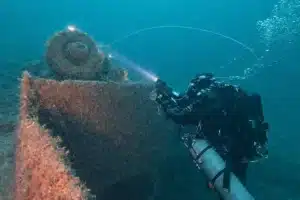
After being hit, G-85 sank in the Dover Strait. The precise modern condition, depth, and identification details of any wreckage are not set out here because they have not been supplied for this article, and guessing would be worse than silence. The Channel already has enough confidently repeated nonsense without our help.
What can be said is that G-85 represents one of the First World War losses linked to the Dover Barrage battles. For anyone researching or planning dives in the area, the sensible approach is to separate the documented wartime event from modern dive-site claims unless those claims are supported by reliable local records.
Casualties and uncertainty
Casualty figures for actions like this need careful handling. A G-85-specific account gives 35 killed. Wider summaries of the Second Battle of Dover Strait can vary, partly because they combine losses from several vessels, count wounded differently, or compress a messy night into a tidy paragraph. Tidy paragraphs are convenient; they are not always kind to truth.
For that reason, 35 killed is best presented as a specific reported figure for G-85, not as a universal final answer to every casualty question about the battle. The important point is simpler and heavier: this was a fatal engagement, and the wreck-history should be read accordingly.
Diving and history significance
For UK wreck divers, G-85 is significant less as a bucket-list target than as context. The Dover Strait is layered with patrol craft, merchant losses, mine warfare, and naval actions. Researching G-85 helps place nearby wartime Channel wrecks, including stories such as HMS Flirt and the First Battle of Dover Strait, in their proper chain.
G-85 in brief
G-85 was a Flanders-based large torpedo boat sunk on 20–21 April 1917, probably by HMS Swift, during a Dover Barrage raid. Treat the story, and any site, respectfully.