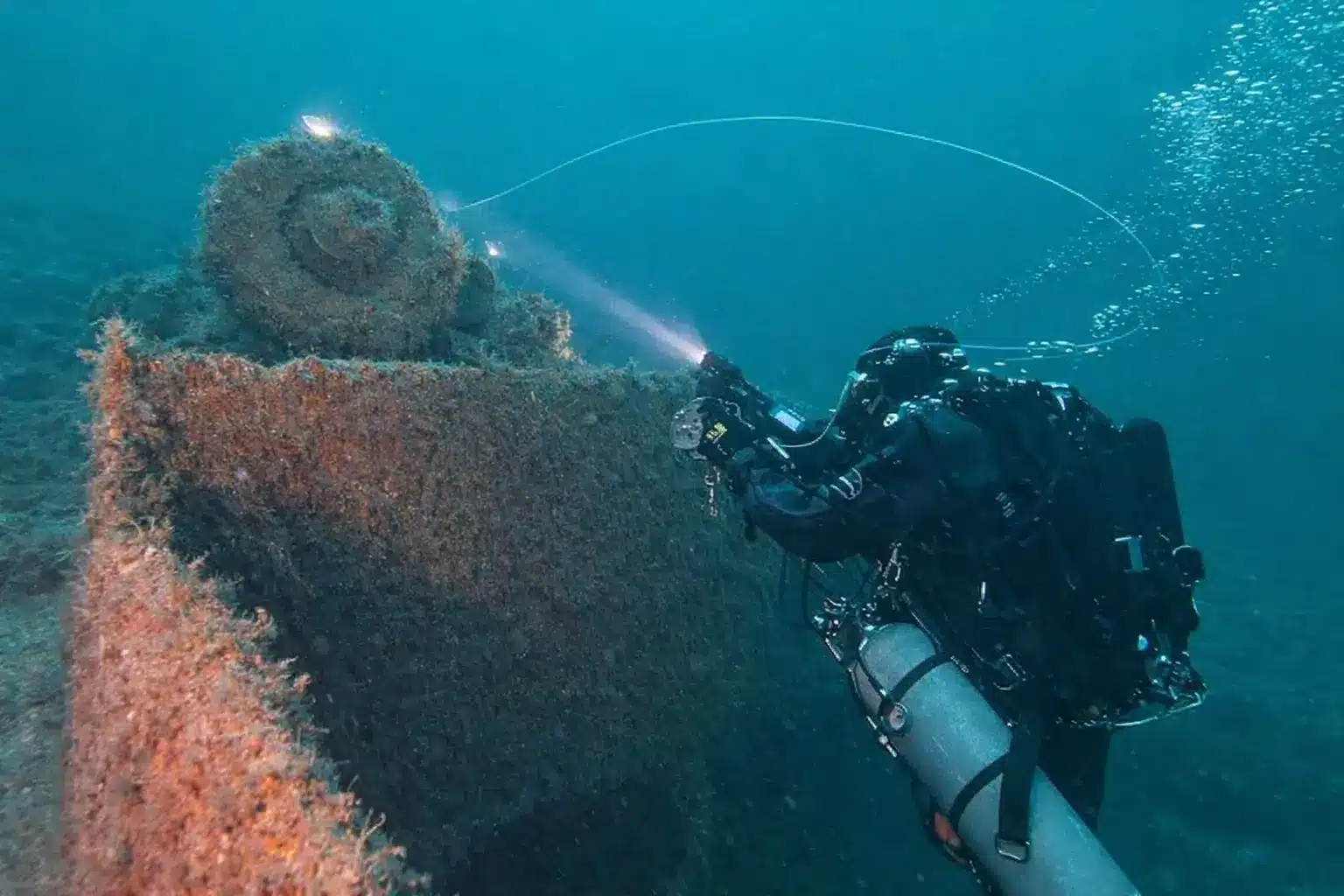
Lying around 5 miles south of Dover, the wrecks of SS Laristan and SV Denbighshire form one of the Channel’s more unusual dive sites. Two vessels, lost years apart, now rest side by side on the seabed, separated by little more than 10 metres and aligned on a similar heading. The site sits in around 25 to 31 metres of water, with both wrecks standing proud and clearly defined, making it possible to explore two distinct ships in a single dive.
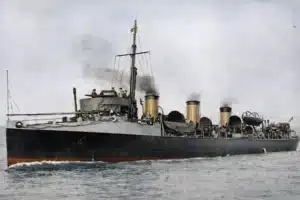
SS Laristan is the larger of the two and dominates the site. She was a British cargo steamer built in 1896 by W. Gray & Co. of West Hartlepool for F.C. Strick & Co. Measuring approximately 2,134 tons and powered by a triple-expansion engine, she was a typical late Victorian steamship. On 22 October 1899, while on passage from Bona to Rotterdam with a cargo of iron ore, she collided with the steamer Crimea in dense fog off the Goodwin Sands. The impact struck her amidships and she sank rapidly. Remarkably, all 23 crew survived, rescued by nearby vessels and landed safely at Dover.
Just a short swim away lies SV Denbighshire, the older of the pair. Built in 1876 by T. Royden & Sons of Liverpool, she was an iron-hulled sailing schooner trading between European ports. At the time of her loss, she was sailing from Dunkirk to Cardiff in ballast when she was involved in a collision off Dover in January 1889. Her cargo holds, empty at the time, remain one of the defining features of the wreck today, large, open, and clean, giving a clear sense of the vessel’s original working layout.
What makes this site special is not just the individual histories, but how they now sit together. Laristan rises higher from the seabed, with sections of hull, plates, and internal structure still standing up to around 10 to 12 metres. Denbighshire, lower and more open, retains the character of a sailing vessel, with its layout easier to interpret once you slow down and separate it from the larger wreck beside it. A third wreck, possibly a barge, is also believed to lie within the same area, adding another layer of confusion for anyone charging about without thinking.
Dropping onto the site, you are effectively stepping into two different periods of maritime history at once. On one side, the industrial weight of steam, boilers, steel plating, and machinery. On the other, the cleaner lines of a working sailing vessel, built for cargo and efficiency under canvas. It is easy to lose orientation if you treat it as a single wreck. Take your time, follow the structure, and the story starts to separate.
This is not a site for ticking boxes. It rewards patience. Sit still for a moment, look properly, and you begin to see it for what it is, not one wreck, but two lives, two losses, and over a century of the Channel quietly rearranging the evidence.