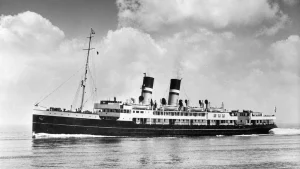

There are ships that become famous because they were large, modern, or victorious. HMS Flirt was none of those things. She was a small, hard-worked, pre-war destroyer, built by Palmers at Jarrow, laid down in September 1896, launched on 15 May 1897 and completed in late 1898. She was a steel, three-funnel 30-knotter, around 65 metres long with a beam of just over 6 metres, armed with one 12-pounder, five 6-pounders and two 18-inch torpedo tubes. By 1916 she was already old for front-line work, coal-fired, cramped and uncomfortable, yet she remained in service with the Dover Patrol, one of the small ships charged with holding the narrow seas against mines, submarines and night raiders.
On the night of 26 to 27 October 1916, the Germans struck the Dover Barrage in force. Their torpedo boats came in under cover of darkness and confusion, attacking the drifters and small patrol vessels that tended the anti-submarine nets. Flirt moved to investigate after gunfire was heard near the drifters. In the blackness, with recognition signals flashing and the enemy moving fast, her officers mistook the approaching German boats for friendly destroyers. It was a fatal error, but also an understandable one in the chaos of a night action fought at close quarters in the Channel.
When Flirt stopped to rescue survivors from the drifter Waveney II and turned on her searchlight, she exposed herself. The Germans came back and hit her at point-blank range. Accounts differ on whether the decisive blow was shellfire, torpedo, or both in quick succession, but the result did not. Flirt was struck amidships, her boilers were wrecked, and she sank within minutes. The men in the boat already away picking up drifter survivors became, in effect, the only men with a real chance of living through what followed. British losses that night were severe across the barrage, but for Flirt the cost was especially cruel: around 60 dead, with only nine survivors.
And yet the reason Flirt endures is not simply the manner of her loss, but the character she had earned before it. In your scuba.to piece, drawing on Captain E.R.G.R. Evans, she is remembered with unusual affection: a grimy, overworked little destroyer that showered her own bridge with cinders and offered precious little comfort below decks, but a ship in which “complaint was unknown” and whose men were known for their cheerfulness. Evans called her “a happy ship”. It is one of those phrases that might sound sentimental if it were not so plainly meant. This was no polished fleet favourite. She was old, filthy, crowded and worn out, but her crew loved her and, when the moment came, she behaved exactly as such a ship should. She went towards the firing, stopped to save others, and then fought a greatly superior force until she was destroyed.


For divers, the wreck of Flirt is more than a narrow hull broken in 38 metres of water. It is the remains of a ship that met the night at its worst and did what was expected of it anyway. The battle around her was messy, confused and brutal, the kind of action that leaves little room for heroics in the theatrical sense. But there was bravery there all the same, in the decision to close the scene, in the searchlight turned on to save men in the water, and in the stubbornness of an elderly destroyer trying to answer an enemy far stronger than herself. More than a century on, the Channel has taken the noise, the flame and the panic. What it has not taken is the feeling that HMS Flirt, poor little Flirt, deserved to be remembered.