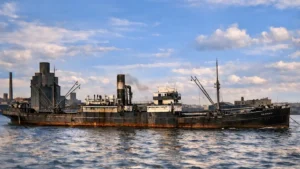

There are wrecks that sink slowly and settle quietly. And then there are those that record, in their very structure, the moment they were lost. SS Efford belongs firmly in the latter.
Built in 1905 by the Dublin Dockyard Company as Shellie, she was a modest British coastal cargo vessel of 339 gross tons. Like many working ships of her kind, she lived several lives. Renamed Dellside in 1933, then New Verdun in 1936, she finally became Efford. By 1940, she was an ageing coaster, still earning her keep in increasingly dangerous waters.
On 22 May 1940, off Dover, Efford collided with the much larger French steamer Tlemcen (4,425 tons). The circumstances sit squarely within the wider chaos of the early Dunkirk period, when the Channel was congested with shipping under pressure. This was not a torpedo or mine strike, but it was no ordinary peacetime accident either. Wartime conditions, heavy traffic, and likely reduced visibility combined to create a situation where a small vessel had little chance.
The impact was catastrophic. Efford was cut in two.
She sank as two separate sections, a detail that defines the dive site today. This is not a single intact wreck, but a broken narrative laid out across the seabed. The bow and stern lie apart, giving divers a rare opportunity to explore the physical evidence of the collision itself.
Reliable records of cargo have not surfaced in accessible sources. As a coaster, she would have been carrying general goods typical of coastal trade, but the exact nature of her final cargo remains unconfirmed. Likewise, confirmed figures for lives lost are not consistently recorded in available public data, and should be treated with caution until primary casualty lists are consulted.
The wreck lies in typical Dover Strait depths, generally in the 20 to 25 metre range, depending on position and tide. The seabed is a mix of sand and shingle, with sections of structure rising modestly above the bottom. Visibility varies with conditions, as any diver familiar with the Channel will expect.
What makes Efford stand out is not simply that she broke apart, but that the wreck now exists as two distinct sites, separated by roughly 0.1 nautical miles. This is not a single continuous wreck. It is a two-drop dive, or at the very least a site that requires clear planning and positioning to explore both sections.
Each part tells only half the story. One section carries the remains of the bow, the other the stern, and the separation between them reflects the sheer force of the collision. For divers, this creates a different kind of experience. Rather than following a wreck from end to end, you are piecing together an event across distance, reconstructing what happened from two scattered fragments.
This is what makes the dive compelling. Not size, not height, but context. You are not looking at a ship that settled intact. You are looking at the aftermath of impact. A small coastal steamer, overwhelmed in a single moment, her structure divided and laid down in two places on the seabed.
In the Dover Strait, where so many wrecks blur into one another, Efford stands apart for one simple reason. It still shows you how it died.