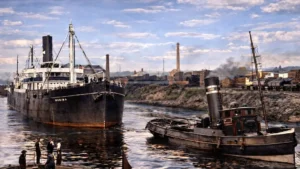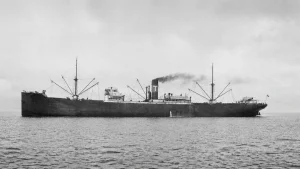

There are wrecks that disappeared into the Channel almost without ceremony, and yet still carry the weight of a far larger story. SS Amplegarth is one of them. Built in 1910 by William Pickersgill & Sons Ltd of Southwick, Sunderland, yard number 168, she was launched on 23 August 1910 and completed the following month. She began life as Denewell, a steel screw steamer of 3,707 gross tons and 2,294 net tons, measuring 348.5 ft in length, 50.2 ft in beam and 23.5 ft in depth. Her engine was a three-cylinder triple-expansion engine by Blair & Co. Ltd, rated at 307 nhp, driving a single screw.
Her early career was that of a working merchant steamer, not a glamorous liner and not a warship, which is precisely why she matters. She was built for the Northern Steamship Co. of Newcastle and later renamed Amplegarth in 1915, when she passed to the Ampleforth Steamship Co., managed by C. Craven & Co. and registered at Cardiff. In 1918 she passed again, this time to the Canute Steamship Co. Ltd, managed by D. & T. G. Adams of Newcastle. So yes, there was a name change, but only one confirmed one: from Denewell to Amplegarth.
Her final voyage ended in wartime, and this was unmistakably a war loss, not a weather wreck and not a routine navigational accident. On 10 May 1918, while on passage from Dunston-on-Tyne to St Nazaire with a cargo of coal, Amplegarth struck a mine 1 mile west-south-west of Dover and sank. The mine was laid by the German minelaying submarine UC-71. Lloyd’s casualty returns list Amplegarth among the 1918 war losses, and contemporary war summaries note her as a 3,707-ton British steamer mined off Dover Harbour. Public shipwreck summaries further state that her crew survived, which is an important detail, because not every wartime Channel loss ended with men getting away alive.
For divers, what makes Amplegarth special is the combination of scale, purpose and context. This is not a tiny coaster or a broken drifter, but a substantial coal-carrying steamship built for hard commercial work and lost at a time when the Dover Strait was under constant threat from mines and submarines. The appeal lies in that contrast: an ordinary merchant vessel caught up in the extraordinary pressures of the First World War.
Amplegarth offers a wartime Channel steamship with a clear identity, a confirmed cargo, a documented name change, and a precise cause of loss. She was not bombed, torpedoed, or driven ashore in a gale. She was mined, quickly and brutally, within sight of one of Britain’s busiest wartime harbours. Exact public details for seabed depth, relief and seabed composition are not confirmed in the sources used here, so those elements should be added only from reliable dive notes or site records. What remains beyond doubt is the story itself: a working steamer, outward bound with coal for France, destroyed by the hidden weapon that made the Channel such a dangerous road in 1918.