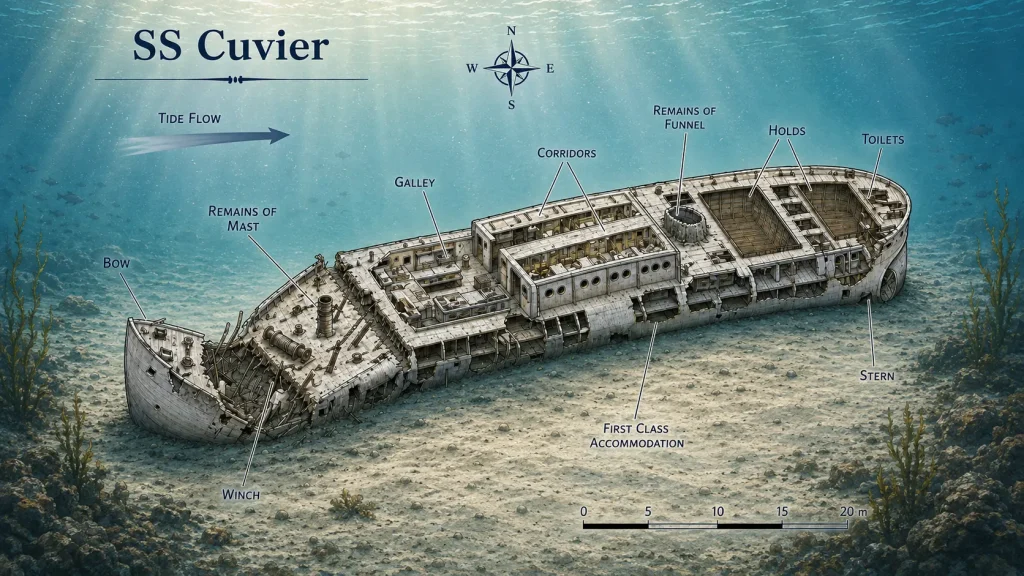

Unidentified Wreck – Local
Unidentified local wreck dive
This unidentified local wreck dive explores one of the many unnamed wreck sites scattered around the Kent coast and Dover Strait. The site may not have a confirmed identity yet, but that is part of the appeal. Every plate, boiler, rib, fitting or cargo trace could help tell us what this vessel was and why she ended up on the seabed.
The Dover Strait has carried merchant ships, naval vessels, fishing boats, barges, coasters and wartime traffic for centuries. As a result, local waters hold a dense mix of known wrecks, suspected wrecks and stubborn seabed marks that still refuse to introduce themselves properly.
Unidentified local wreck dive: why mystery matters
Not every wreck comes with a name, a date and a neat archive entry. Some sites sit in the grey area between survey mark and confirmed wreck. However, these dives often produce the most interesting conversations once everyone is back on deck.
Divers may spot construction clues, cargo remains, machinery, anchors, boilers, winches, plating or timber. In addition, small details can point towards a period, vessel type or possible cause of loss. A wreck does not need a name to have a story. It only needs careful eyes and a little patience.
This kind of dive also helps build local wreck knowledge. Therefore, photographs, video, sketches and sensible notes all matter. Even one clear image of a fitting, maker’s plate or unusual cargo item can shift a site from “mystery lump” to “possible candidate”. That is how proper wreck identification often begins, despite humanity’s continuing belief that guesswork improves after a cup of tea.
What we may find
The Kent coast gives us plenty of possibilities. This could be a small cargo vessel, a sailing ship remnant, a wartime casualty, a barge, a fishing vessel or a broken section from a larger wreck. Alternatively, it may prove to be a scattered debris field rather than a single coherent ship.
Conditions, tide and visibility will decide how much detail we can record. However, the aim is simple: dive the site safely, observe what is there and come back with useful information. If the wreck gives up a clue, we will follow it. If it keeps its secrets, we will at least have had a proper local adventure rather than another evening arguing with Netflix.
Dive approach
This is a local wreck exploration dive, so divers should expect uncertainty. The site may be broken, low-lying, partially buried or covered in fishing gear. Therefore, good buoyancy, awareness and disciplined team diving matter.
Please avoid disturbing the wreck or removing anything from the site. Photographs and video tell the story better than pocketed objects. In addition, responsible recording helps protect the wreck and gives us a better chance of working out what we are looking at.
This dive suits divers who enjoy exploration, wreck history and the challenge of piecing together evidence underwater. It is less about ticking off a famous name and more about helping uncover the identity of a local wreck that has stayed quiet for too long.
Are you a Mutiny Diver? Book more dives.