
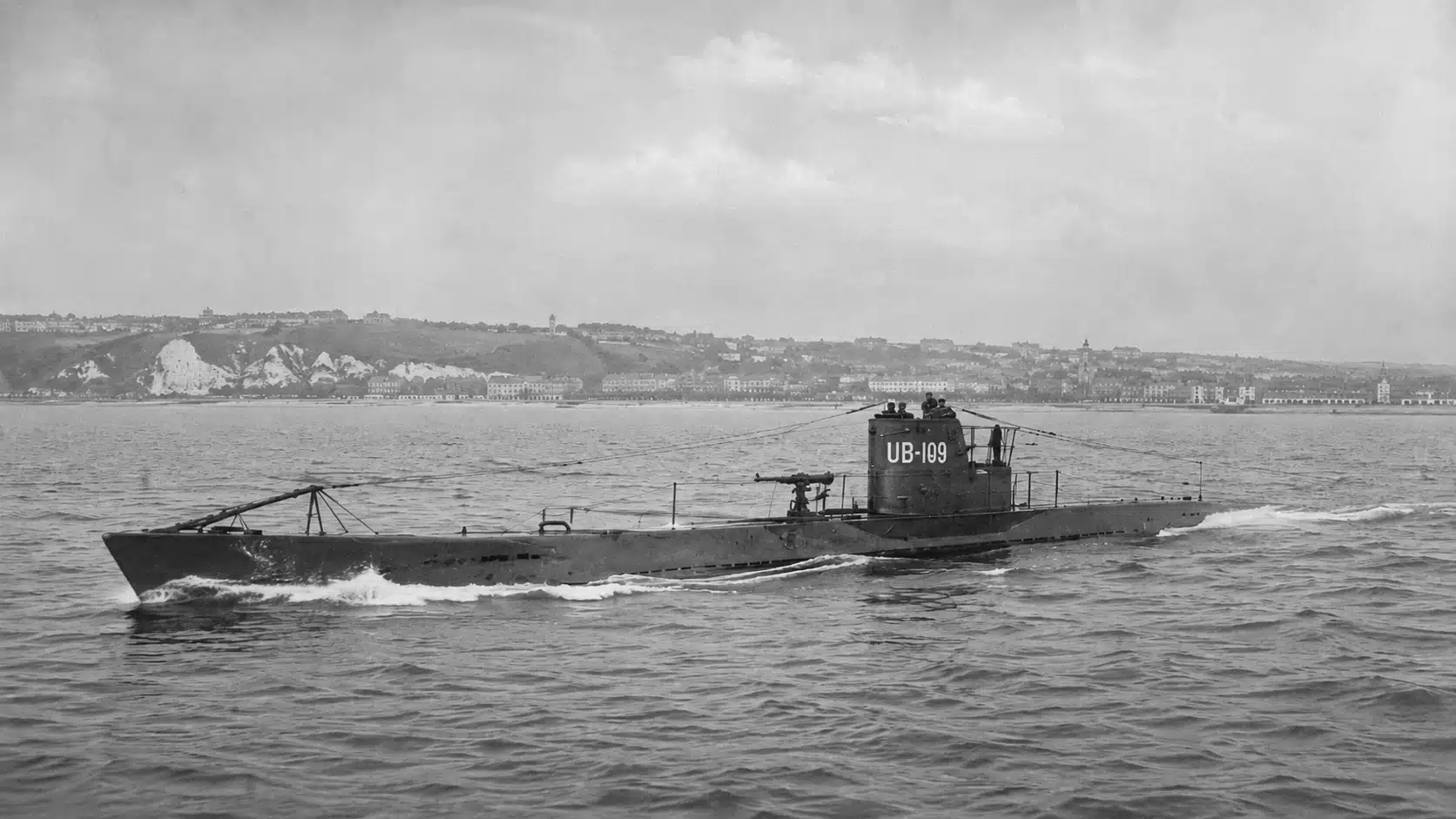
U-Boat SM UB-109 (1918)
SM UB-109 wreck dive
The SM UB-109 wreck dive explores the remains of a German Type UB III submarine lost off Folkestone in 1918. UB-109 had completed a dangerous Atlantic patrol and was trying to return through the Dover Barrage when British shore-controlled mines destroyed her. As a result, twenty-eight men died and eight survived.
This SM UB-109 wreck dive tells one of the sharper late-war Dover Strait stories. The submarine passed through the barrage on her outward journey, but British forces changed the defences while she remained at sea. Therefore, when UB-109 returned, the route she expected to use had become a trap.
SM UB-109 wreck dive: the submarine before the loss
Blohm & Voss built UB-109 at Hamburg as yard number 315. Germany ordered her on 23 September 1916, launched her on 7 July 1917 and commissioned her on 31 December 1917. Kapitänleutnant Kurt Ramien commanded her throughout her operational career.
UB-109 belonged to the Type UB III class. These submarines worked as seagoing attack boats, larger and more capable than the earlier coastal UB types. They carried torpedoes and a deck gun, which allowed them to attack merchant shipping across wider patrol areas.
By March 1918, UB-109 had joined the Flandern I Flotilla. From the Belgian coast, these boats threatened shipping in the Channel, the North Sea and the Atlantic approaches. Consequently, the Dover Strait became both an escape route and a killing ground.
The final patrol and the Folkestone Gate
UB-109 left Zeebrugge in the early hours of 28 July 1918. She passed through the Dover Barrage outward-bound and headed towards the Atlantic. During that patrol, she added to a wartime record that eventually reached seven ships sunk, totalling 14,092 tons.
However, the British improved the Dover Barrage while Ramien and his crew were away. The Folkestone Gate had allowed friendly surface traffic through the mine defences. Then British forces closed the gap with shore-controlled mines linked to detection systems.
On 29 August 1918, UB-109 tried to return through the same general route. A patrol vessel appears to have forced her to alter course and submerge. Then the shore-controlled minefield detonated as she crossed the defended area.
The explosion broke the submarine and flooded her fast. Eight men escaped and were taken prisoner, but twenty-eight died. British naval divers reached the wreck quickly afterwards and recovered valuable intelligence material from the boat.
You can read the vessel record in Uboat.net’s UB-109 entry. Historic England’s archaeological summary appears in Historic England’s UB-109 wreck record.
The wreck today
The wreck lies off Folkestone and forms part of the wider archaeology of the Dover Barrage. Historic England records the site in territorial waters at about 51°03.731’N, 001°14.146’E. The archaeological survey found the submarine in two main sections.
The forward section remains upright, while the smaller stern section lies upside down to the south-west. The break sits aft of the conning tower area, which fits the expected damage from the shore-controlled mine detonation. In addition, survey records note the 8.8 cm gun, the partly extended attack periscope and the sand-filled hull.
For divers, UB-109 offers more than a submarine silhouette on the seabed. It shows how the Dover Barrage developed into a deadly system of mines, listening stations, patrol vessels and intelligence work. Finally, it gives the dive real human weight: thirty-six men entered the barrage, eight came out alive.
Are you a Mutiny Diver? Book more dives.