

The Mindora was a British three-masted barque, reportedly constructed in August 1864 and measuring about 41.5 metres long. She was a newly built sailing vessel, bound outward from London to Victoria, British Columbia, carrying passengers and what contemporary reports describe as a valuable general cargo. That phrase does a lot of heavy lifting, as Victorian shipping reports often preferred suspense over inventory, presumably to torment future wreck researchers for sport. Local dive accounts place the wreck in the 30 to 32 metre range off Dover.
Her career was brutally short. On 28 November 1864, Mindora collided in the English Channel with the Khersonese, another outward-bound sailing ship, reportedly on passage from London to Calcutta. Contemporary shipwreck listings place the collision about 8 nautical miles south-west by west of South Foreland, with Mindora sinking and the other vessel abandoned in a sinking condition. For divers, this is a proper Victorian mystery wreck: a young barque lost almost as soon as her story began, a collision in one of the world’s busiest sea lanes, and a seabed site that still gives up small clues from a long-vanished age of sail.
Stefan Panis finds a 162 Year Old Bottle of Guinness
Mindoro is one of those wrecks that reminds you why we go wreck diving in the first place.
The wooden sailing ship sank in 1864 and today lies partially buried in the shifting sands off Dover. Currents constantly change the site, covering parts of the wreck and revealing others. That means no two seasons necessarily show you quite the same Mindoro. She has long been known to local divers as the “Bottle Wreck”, and recently that nickname became considerably more interesting.
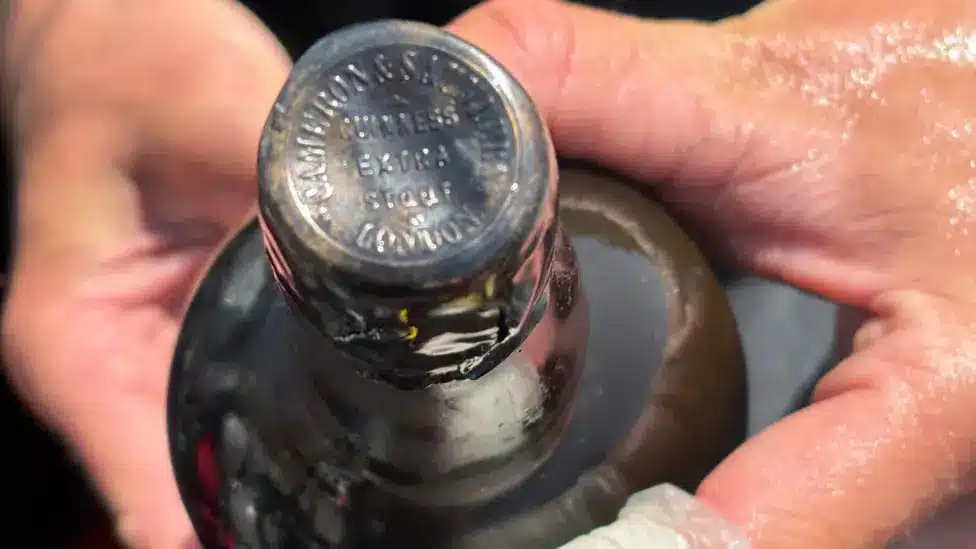
During a dive on Mindoro, renowned Belgian wreck diver and underwater photographer Stefan Panis discovered a wooden case containing lead-sealed bottles. After clearing the top of the case, the wording appeared:
Guinness Extra Stout, London.
One of those bottles has since been recovered for research and may represent one of the oldest surviving bottles of Guinness, having spent more than 160 years beneath the English Channel. It’s more than a great story to tell over a pint.
Finds such as this help reveal what these ships were carrying, where goods were being traded and how everyday products travelled around Victorian Britain and Europe. An apparently ordinary bottle on the seabed suddenly becomes a small piece of social and maritime history. And there may be more down there.
The sands around Mindoro continue to move, exposing bottles, timbers and previously hidden sections of the wreck. You’re not diving a static museum exhibit. You’re diving an archaeological site that is still changing and still giving up its secrets.
Perhaps leave the Guinness where it is, though. After 162 years on the seabed, it probably won’t qualify as a refreshing post-dive pint.