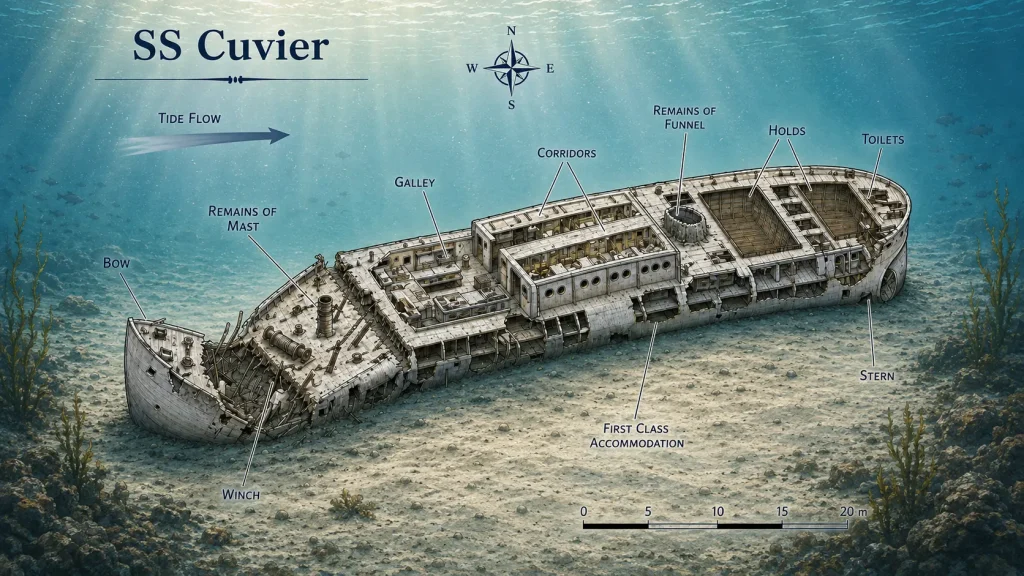

SS Port Dalhousie (1916)
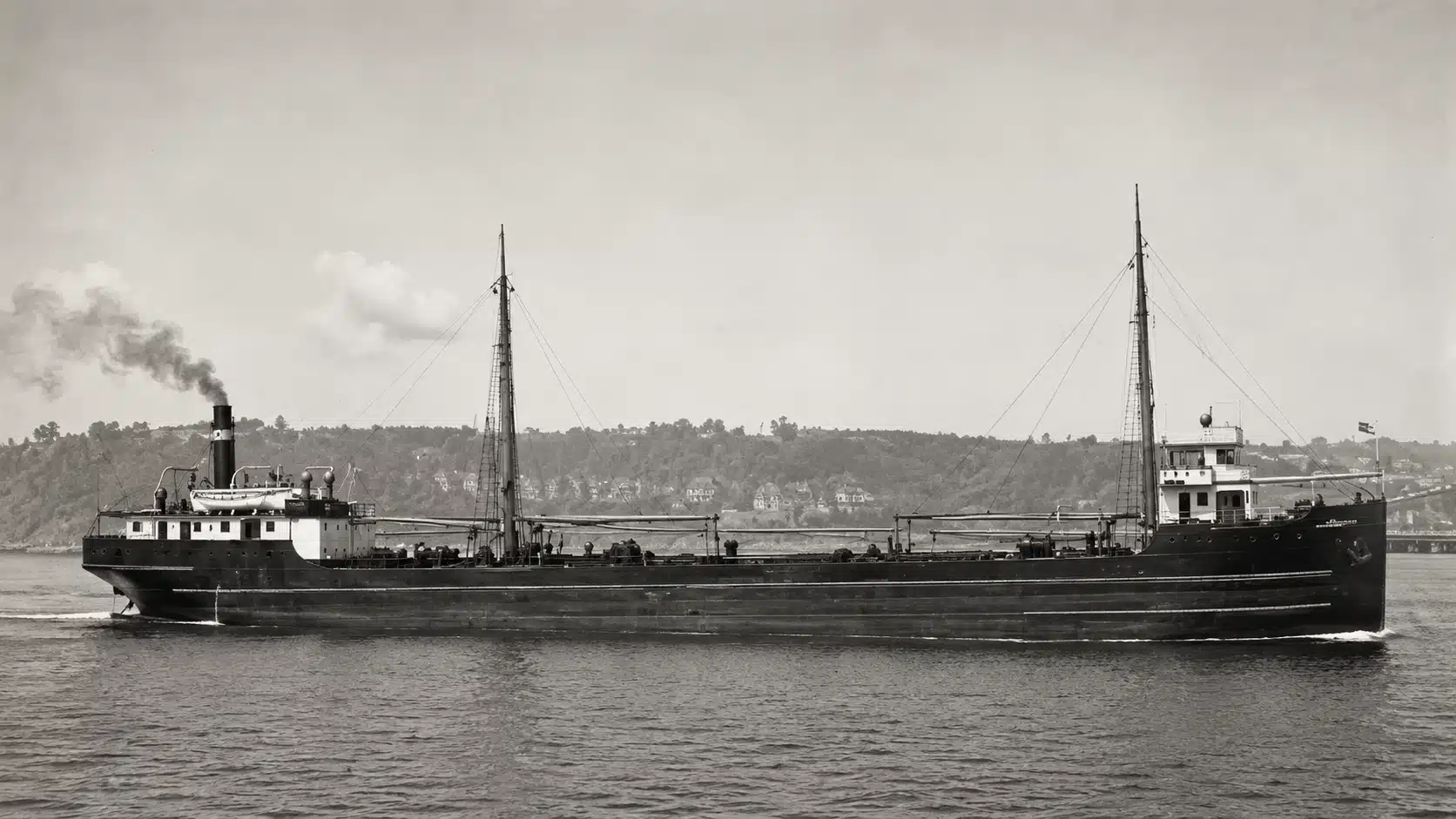
SS Port Dalhousie wreck dive
The SS Port Dalhousie wreck dive explores a First World War cargo ship lost off Kentish Knock in 1916. Port Dalhousie was sailing from Middlesbrough to Nantes with steel billets when German submarine UB-10 torpedoed her. The attack sank a Canadian-operated ship with an unusually interesting engineering history.
This SS Port Dalhousie wreck dive is more than another wartime merchant loss. Before she became Port Dalhousie, she was built as Tynemount by Smith’s Dock at Middlesbrough. She had also been linked with early diesel-electric propulsion, which gives this wreck a technical story as well as a wartime one.
SS Port Dalhousie wreck dive: the ship before the war
Smith’s Dock Co. Ltd. built the vessel at Middlesbrough in 1913. She was completed for the Electric Marine Propulsion Co. Ltd. as Tynemount. From 1914, she was owned by Reuben A. McLelland of Kingston, Ontario, and carried the name Port Dalhousie.
Her design aimed at St Lawrence River and Great Lakes trading. Great Lakes vessel history describes her as a canal-size bulk freighter, about 78 m long overall, with a beam of about 12.9 m. However, her original diesel-electric machinery did not suit the expected service, so she was later repowered with more conventional equipment.
By 1915, the war had pulled her away from lake and river trading. She left Great Lakes service and moved into wartime sea work. As a result, a vessel built for inland and coastal commercial use found herself exposed to the U-boat campaign off the east coast of England.
The sinking off Kentish Knock
On 19 March 1916, Port Dalhousie was bound from Middlesbrough to Nantes with a cargo of steel billets. Steel billets were semi-finished metal products, useful for further rolling and manufacturing. In wartime, cargo like this had obvious industrial value.
German submarine UB-10, commanded by Reinhold Saltzwedel, attacked her near the Kentish Knock Light Vessel. Uboat.net places the sinking about 2 miles south-half-west of the light vessel. The torpedo hit ended her voyage before she could reach France.
The casualty record needs careful handling. Uboat.net records 19 casualties, while memorial-based research currently identifies 12 named dead. Those named include Master William Butler, Chief Engineer Charles Rolli Bydder, Second Mate James Graham Farrow and several crewmen from Britain, Canada, Norway, Jamaica and the West Indies.
You can read the attack summary in Uboat.net’s Port Dalhousie record. A memorial-based casualty list appears in Benjidog’s Merchant Navy Memorial research.
The wreck today
Port Dalhousie gives divers a compact First World War merchant wreck with a strong Kent coast setting. The story connects Middlesbrough shipbuilding, Canadian ownership, Great Lakes trading, industrial cargo and the U-boat war in one wreck.
That makes the dive historically rich without needing to overcook the drama. A cargo ship left Middlesbrough with steel for France. A small German coastal submarine found her near Kentish Knock. Then the Channel did what the Channel does best: kept the evidence and made everyone else argue over the details.
Are you a Mutiny Diver? Book more dives.