
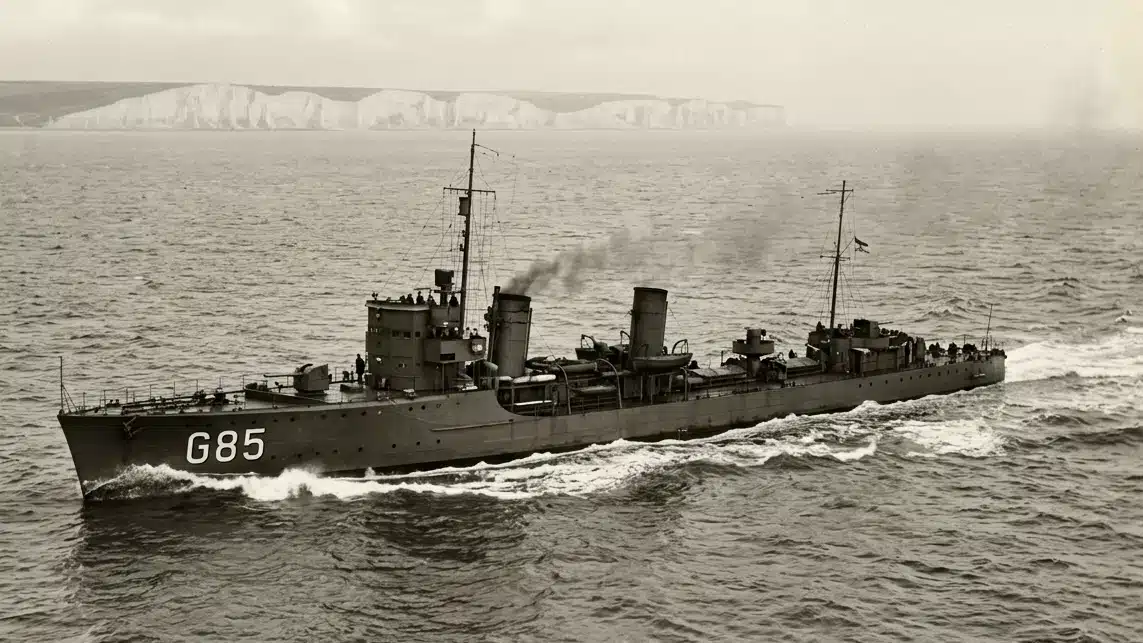
Großes Torpedoboot SMS G-85 (1917)
SMS G-85 wreck dive
The SMS G-85 wreck dive visits the remains of a German large torpedo boat lost during the Battle of Dover Strait in 1917. SMS G-85, also written G85, was not a cargo ship or civilian casualty. She was a fast Imperial German Navy warship sent into the Channel to attack the Dover Barrage.
This SMS G-85 wreck dive brings you close to one of the most dramatic night actions fought off the Kent coast. On 21 April 1917, HMS Swift and HMS Broke intercepted German torpedo boats in a confused and violent clash. Therefore, this is a wreck with a proper combat story, not a polite little sinking caused by bad weather and poor life choices.
SMS G-85 wreck dive: the ship before the battle
SMS G-85 was a Großes Torpedoboot, or large torpedo boat, built for the Imperial German Navy. Germaniawerft built her at Kiel, and she launched on 24 July 1915. She entered service later that year, on 14 December 1915.
Although called a torpedo boat, G-85 was closer in role and size to an early destroyer. She measured about 83 m long, carried three 10.5 cm guns and mounted six 50 cm torpedo tubes. In addition, she could carry mines, which made her useful for offensive raids in the North Sea and English Channel.
By spring 1917, G-85 had joined German torpedo boat forces operating from Flanders. These fast ships targeted the Dover Patrol, the Dover Barrage and Allied traffic moving through the Channel. As a result, they posed a direct threat to the guarded sea route between Britain and the Western Front.
The Battle of Dover Strait
On the night of 20/21 April 1917, fifteen German torpedo boats left Flanders in three groups. G-85 formed part of Gruppe Gautier, alongside G42, S53, V71, V73 and V81. Their orders were to attack the Dover Barrage and bombard Dover.
The German force first encountered the trawler Sabreur and opened fire. However, Sabreur escaped with damage. Gruppe Gautier then shelled Dover, where British coastal artillery replied before the German vessels turned back towards the Channel.
During the withdrawal, the British flotilla leaders HMS Swift and HMS Broke intercepted the German boats. In the darkness and confusion, HMS Swift torpedoed G-85, bringing her to a halt and setting her on fire. Meanwhile, HMS Broke rammed G42, and the two ships became locked together in a brutal close-quarters fight.
After Broke broke clear from G42, she moved towards the disabled G-85 and opened fire. Both German torpedo boats sank during the action. Thirty-five of G-85’s crew were killed, although I have not found a reliable named casualty list in the accessible records.
You can read the main wreck record through Historic England’s Dover Strait wreck record. For a fuller account of the naval action, see Naval-History.Net’s Dover destroyer action account.
The wreck today
The wreck site identification carries some historical caution. G42 and G-85 sank in the same battle, and records have sometimes treated the two sites with uncertainty. Historic England notes a wreck believed to be G42 east of South Foreland, while the site believed to be G-85 lies farther east.
That uncertainty adds interest rather than weakness. The wreck still represents one of the two German torpedo boats destroyed during the Battle of Dover Strait. For divers, it offers a compact but powerful First World War story: speed, darkness, torpedoes, ramming and the Dover Patrol doing its job with very little subtlety.
Are you a Mutiny Diver? Book more dives.