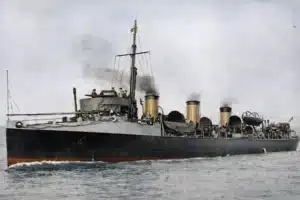

In 1864, the three-masted British barque Mindora met her end in the English Channel, one of the busiest and most unforgiving stretches of water in the world.
She belonged to the great age of sail, when merchant vessels carried cargoes between British ports and markets across Europe and beyond. Built as a barque, Mindora combined square sails on her fore and main masts with fore-and-aft rigging on the mizzen, a practical arrangement that gave vessels of her type good ocean-going performance without demanding the huge crews required by fully square-rigged ships.
For a working merchant vessel, the English Channel could be every bit as dangerous as an ocean passage. Shipping converged towards the narrow waters between Britain and continental Europe, while fog, darkness, strong tides and uncertain visibility could rapidly turn routine navigation into something far more serious. There was no radar, AIS or electronic chartplotter. Collision avoidance relied upon sharp eyes, competent seamanship and, when visibility deteriorated, a considerable measure of judgement.
Mindora’s final voyage ended in collision.
The impact was sufficiently serious to leave the vessel beyond saving. What followed would have been sudden and chaotic: damage assessed, pumps manned if there was any hope of keeping her afloat, boats prepared and the crew ordered to abandon ship as the situation deteriorated.
Whether Mindora disappeared beneath the surface quickly or remained afloat for a time is uncertain. Either way, another hard-working merchant ship had become one of the thousands of vessels eventually claimed by the Channel.
For more than a century, that might have been where the story ended.
Instead, the seabed has begun giving parts of Mindora’s story back.
The wreck lies partly buried within the mobile sands of the Dover Strait. Strong tides move sediment across the site, concealing sections of wreckage and occasionally exposing timbers and cargo that may have remained hidden for decades. Local divers consequently came to know Mindora as the “Bottle Wreck”, a name that became considerably more significant when Belgian wreck diver and underwater photographer Stefan Panis discovered a wooden case containing sealed bottles.
Carefully exposing the top of the case revealed something extraordinary:
Guinness Extra Stout, London.
One of the bottles has since been recovered for research after spending more than 160 years beneath the English Channel.
It is a wonderfully tangible connection with the ship.
A bottle of stout might appear insignificant beside anchors, timbers and the remains of a large sailing vessel, but finds like this can tell us far more about a wreck than their size suggests. Cargo can help reveal trading routes, commercial connections and the everyday goods moving through Victorian ports. In this case, an intact bottle turns an anonymous mound of wreckage into something immediately recognisable: a product being shipped and consumed while Queen Victoria was on the throne and commercial sail still carried much of Britain’s trade.
That is part of what makes Mindora such an intriguing dive today.
You are not simply descending onto the remains of a ship lost in 1864. You are visiting a wreck whose story is still being uncovered. The sands continue to move, sections appear and disappear, and objects that have remained hidden for generations can occasionally emerge again.
Somewhere beneath those sands may still be more of Mindora’s cargo, more of her structure and perhaps further clues to the life of the vessel before that final collision.
And, apparently, possibly a little more Guinness.
Stefan Panis finds a 162 Year Old Bottle of Guinness
Mindoro is one of those wrecks that reminds you why we go wreck diving in the first place.
The wooden sailing ship sank in 1864 and today lies partially buried in the shifting sands off Dover. Currents constantly change the site, covering parts of the wreck and revealing others. That means no two seasons necessarily show you quite the same Mindoro. She has long been known to local divers as the “Bottle Wreck”, and recently that nickname became considerably more interesting.
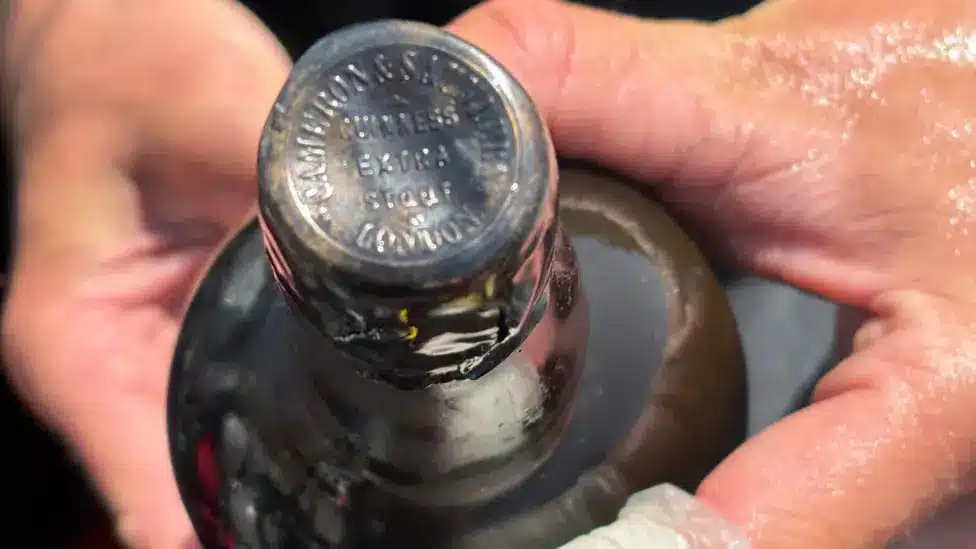
During a dive on Mindoro, renowned Belgian wreck diver and underwater photographer Stefan Panis discovered a wooden case containing lead-sealed bottles. After clearing the top of the case, the wording appeared:
Guinness Extra Stout, London.
One of those bottles has since been recovered for research and may represent one of the oldest surviving bottles of Guinness, having spent more than 160 years beneath the English Channel. It’s more than a great story to tell over a pint.
Finds such as this help reveal what these ships were carrying, where goods were being traded and how everyday products travelled around Victorian Britain and Europe. An apparently ordinary bottle on the seabed suddenly becomes a small piece of social and maritime history. And there may be more down there.
The sands around Mindoro continue to move, exposing bottles, timbers and previously hidden sections of the wreck. You’re not diving a static museum exhibit. You’re diving an archaeological site that is still changing and still giving up its secrets.
Perhaps leave the Guinness where it is, though. After 162 years on the seabed, it probably won’t qualify as a refreshing post-dive pint.